Q31 · 9708/22/O/N/22 Q2
Worked solution from the Government macroeconomic intervention Theory (Paper 2) booklet, Part 3 of 4.

Worked solution
(a)
Cover what counts as money, how contactless payment fits, and the effect on at least two functions of money.
Write: money in a modern economy includes the narrow measure: cash. [1]
and the broad measure: bank deposits (savings). [1]
Contactless payments fit within money because they are just another way of moving bank deposits and replace cash in buying goods and services. [1]
They rely on mobile phone technology or apps, or cards used without a PIN. [1]
Function 1, medium (means) of exchange: deposits can still be used to pay, but this depends on access to technology. [1]
Explain why: people without phones or cards could not use contactless payments, so it is accepted only where the technology exists. [1]
Function 2, store of value: people may need to keep more money on deposit to make payments. [1]
Explain why: deposits only work as money if they are liquid enough to be spent at once. [1]
(Instead of store of value, you may use standard of deferred payment: credit cards and overdrafts let payments be made later.)
(b)
Discuss with reasons it works, reasons it may not, and a judgement.
Expansionary monetary policy means lowering the interest rate or increasing the money supply. Cheaper borrowing raises consumption. [1]
Cheaper borrowing also raises investment by firms. [1]
A lower exchange rate makes exports cheaper and imports dearer, so net exports rise. (Write about more than one component of AD.) [1]
With these components of AD rising, AD shifts right, output and the price level rise, which corrects deflation. [1]
Why it might not: a lack of consumer confidence means households do not borrow or spend even when interest rates are low. [1]
A lack of business confidence means firms do not invest. [1]
Banks may not lend even if the money supply increases. [1]
The overall situation of the economy matters: if interest rates are already very low they cannot be cut much further. [1]
Evaluation: it depends on whether the problem is weak demand and on the overall situation of the economy; policy works better if confidence is good. [1]
For the exchange rate route, the effect depends on the PED of exports and imports. [1]
Weigh how big these problems are against the gains from the policy. [1]
Conclusion: write a reasoned view, for example that it is likely to help only if people are willing to borrow and spend. [1]
Official mark scheme

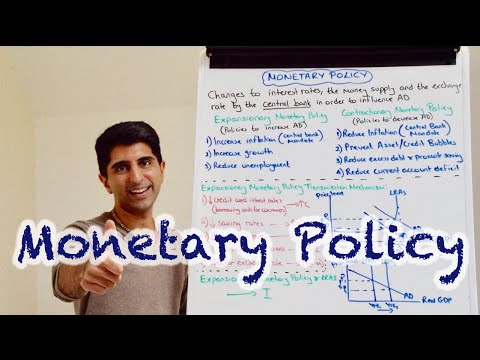 ▶ Topic lesson
A lesson on this topic · by EconplusDal. Tap the picture to open it on YouTube.
Solutions follow the official Cambridge mark schemes; marks are shown in grey. Videos are from other YouTube channels. Paper codes read component / series / year: M/J = May/June, O/N = October/November. Past-paper questions © UCLES, reproduced for classroom practice.