Q17 · 9708/21/M/J/23 Q1
Worked solution from the The macroeconomy Theory (Paper 2) booklet, Part 4 of 5.

Worked solution
(a)
Read the two values from Fig. 1.1: July 2020 = 7.4% and May 2021 = 11.9%. [1]
Change = 11.9% − 7.4% = 4.5 percentage points (an increase of 4.5%). [1]
(You can also give the percentage change instead: 4.5 ÷ 7.4 × 100 = 60.8%, so 60% or 61%.)
(b)
The agricultural sector failed to absorb the extra labour: December is not a good month for farming, which needs fewer workers, so jobs are lost rather than created. [1]
In December 2020, 9.8 million jobs were lost in agriculture, more than the 6 million additional labour (labour force 421 million → 427 million). [1]
(c)
Consider means: give difficulties, then say how serious they are.
Inactive workers are not looking for work but might if their situation changed, so they are not counted. [1]
Discouraged workers have had no success finding work and stop looking. [1]
Disguised unemployment: people count as employed but do no meaningful work. (Another point; any three earn the marks.)
Unreported employment: some workers registered as unemployed are really working in the illegal, underground or informal economy. [1]
(Other valid points: the efficiency of tax collection, the scale of the survey, and difficulty of measuring in rural areas. Up to 2 marks for a fully explained point, maximum 3 in total from the points above.)
Evaluation: judge how far these are significant difficulties for India, for example that the large informal and rural sectors make the measured figure unreliable. [1]
(d)
Assess means: explain both types, then judge.
Seasonal unemployment: farming needs fewer workers in December, and in December 2020 agriculture lost 9.8 million jobs; it is temporary and linked to the time of year. [2]
Frictional unemployment: new workers (labour force 421 million → 427 million) were unable to find work immediately because they are reluctant to relocate (geographical immobility) or are unaware of vacancies. [2]
Evaluation: consider both types, for example that frictional unemployment is usually short-term, while seasonal unemployment returns every year in the same sectors. [1]
Conclude on which is more serious for India's economy and how far, with a reason. [1]
(e)
Assess means: explain the measures, with their problems, then judge.
Fiscal policy: cut taxes and/or raise public spending, for example on infrastructure projects; the problems include a bigger budget deficit and time lags. [2]
Monetary policy: cut interest rates and/or increase the money supply; the problems include possible inflation and weak effect if borrowers lack confidence. [2]
Supply-side policies: make the labour market more flexible, give more training and retraining, reduce disincentives to work (for example lower unemployment benefits and lower marginal tax rates) and encourage investment; the problems include being slow and costly. (Any two of the three groups, with problems, earn the 4 marks.)
Evaluation: the best measure depends on the extent of unemployment (Fig. 1.1: between 6.5% in November 2020 and January 2021 and 11.9% in May 2021), whether the measures are short-term or long-term (supply-side policies take longer), and whether unemployment is concentrated in particular regions. [1]
Conclude with a justified judgement on which measures would work best for a country such as India. [1]
Official mark scheme

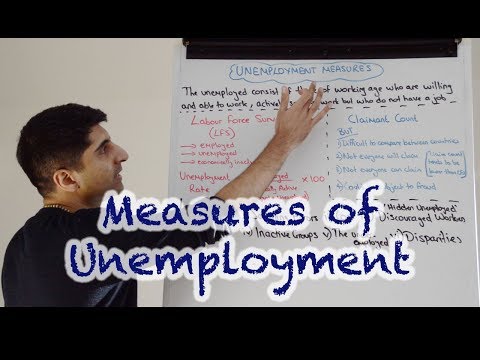 ▶ Topic lesson
A lesson on this topic · by EconplusDal. Tap the picture to open it on YouTube.
Solutions follow the official Cambridge mark schemes; marks are shown in grey. Videos are from other YouTube channels. Paper codes read component / series / year: M/J = May/June, O/N = October/November. Past-paper questions © UCLES, reproduced for classroom practice.