Q3 · 9701/21/O/N/21 Q1
Worked solution from the Chemical energetics Theory (Paper 2) booklet, Part 1 of 2.

Worked solution
(a)(i)
Write: it easily turns into a gas (evaporates easily). [1]
(a)(ii)
CS2 has two C=S double bonds. Carbon has 4 outer electrons and each sulfur has 6.
Draw C in the middle with two sulfur atoms either side. Between C and each S, show two shared pairs (4 electrons), with the C electrons as crosses and the S electrons as dots. [1]
Show 2 lone pairs (4 more electrons) on each S atom, so each S has 8 electrons in total. [1]
(a)(iii)
Carbon has two bonding regions and no lone pairs, so the molecule is linear.
Write: 180° [1]
(a)(iv)
Both are simple molecules. Only weak forces between the molecules need to be overcome, and these depend on the number of electrons.
Write: CS2 has more electrons than CO2. [1]
So it has stronger induced dipole (London) forces between its molecules, which is why it is a liquid. [1]
(b)(i)
Write: the enthalpy change when 1 mole of a compound [1]
burns completely in excess oxygen. [1]
(b)(ii)
ΔHc = ΣΔHf(products) − ΣΔHf(reactants). O2 is an element, so its ΔHf is zero.
ΔHc = [−394 + 2 × (−297)] − (+89.7) [1]
= −988 − 89.7
Write: ΔHc = −1080 kJ mol−1 (−1077.7 before rounding) [1]
(c)(i)
Write: a weak acid partially dissociates (ionises) in water, giving H+ ions. [1]
(c)(ii)
A conjugate base is the acid after losing one H+.
Write: HS− [1]
(c)(iii)
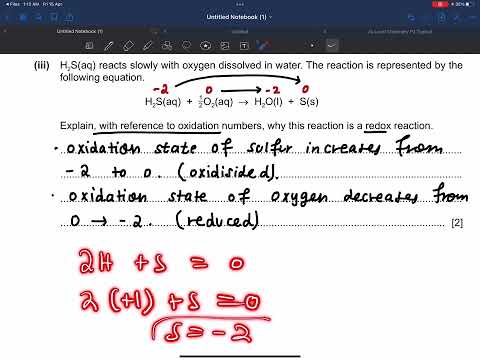
Work out the oxidation numbers on each side.
Write: sulfur goes from −2 in H2S to 0 in S. Its oxidation number increases, so it is oxidised. [1]
Write: oxygen goes from 0 in O2 to −2 in H2O. Its oxidation number decreases, so it is reduced. Both happen together, so it is redox. [1]
(d)(i)
Mr of As2S3 = 2 × 74.9 + 3 × 32.1 = 246.1
Moles As2S3 = 0.198 ÷ 246.1 = 8.05 × 10⁻⁴ mol [1]
SO2 formed: 2 mol As2S3 gives 6 mol SO2, so moles = 3 × 8.05 × 10−4 = 2.41 × 10⁻³ mol
Volume SO2 = 2.41 × 10−3 × 24.0 = 0.0579 dm3 [1]
O2 used: 2 mol As2S3 needs 9 mol O2, so moles = 8.05 × 10−4 × 9/2 = 3.62 × 10⁻³ mol
Volume O2 used = 3.62 × 10−3 × 24.0 = 0.0869 dm3 [1]
O2 left = 0.100 − 0.0869 = 0.0131 dm3. The As4O6 is a solid, so it adds no gas.
Total gas = 0.0131 + 0.0579 = 0.0710
Write: 0.071 dm3 [1]
(d)(ii)
Write: it causes acid rain. [1]
(d)(iii)
SO2 is an acidic oxide. With 2 mol NaOH it forms sodium sulfite and water.
Write: SO2(g) + 2NaOH(aq) → Na2SO3(aq) + H2O(l) with the right species and balancing. [1]
The state symbols (g), (aq), (aq) and (l) are all correct. [1]
Official mark scheme

 ▶ Whole paper
Video solution of the whole paper · by Ahmed. Tap the picture to open it on YouTube.
Solutions follow the official Cambridge mark schemes; marks are shown in grey. Videos are from other YouTube channels. Paper codes read component / series / year: M/J = May/June, O/N = October/November. Past-paper questions © UCLES, reproduced for classroom practice.