Q28 · 9700/43/M/J/22 Q7
Worked solution from the Inheritance Theory (Paper 4) booklet, Part 2 of 3.

Worked solution
(a)
Write: a gene is a length of DNA (sequence of nucleotides) that codes for a particular protein/polypeptide. [1]
Write: a locus is the position of a gene/allele on a chromosome. [1]
(b)
Parent phenotypes: both mice are brown (they have A, so make pigment, and B, so brown). [1]
Gametes from each parent: AB, Ab, aB, ab. [1]
Draw the 4 × 4 Punnett square: AABB, AABb, AaBB, AaBb across the top row for AB, and so on. All 16 genotypes correct. [2]
Phenotypes: A_B_ = brown (9), A_bb = black (3), aaB_ and aabb = white (4), because aa gives no pigment whatever the B gene is (epistasis). [1]
Ratio: 9 brown : 3 black : 4 white [1]
(c)
Write any three of these points.
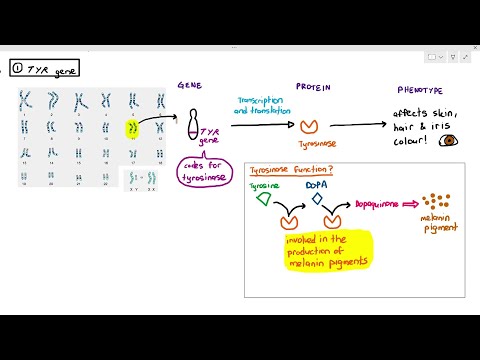
A base substitution, deletion or insertion (frame shift) in the TYR gene. [1]
This changes the primary structure / 3D shape (active site) of the enzyme, or introduces a stop codon. [1]
So no active tyrosinase is made, tyrosine is not converted to DOPA/dopaquinone, and melanin is not formed. [1]
Official mark scheme

 ▶ Topic lesson
A lesson on this topic · by OtterBioTutor. Tap the picture to open it on YouTube.
Solutions follow the official Cambridge mark schemes; marks are shown in grey. Videos are from other YouTube channels. Paper codes read component / series / year: M/J = May/June, O/N = October/November. Past-paper questions © UCLES, reproduced for classroom practice.