Q47 · 9701/13/M/J/23 Q25
Worked solution from the Group 17 MCQ booklet.

Worked solution
The question asks why NaBr gives Br2 with concentrated H2SO4 but NaCl only gives HCl.
Concentrated H2SO4 first gives HBr or HCl. It can then act as an oxidising agent.
Br– is a stronger reducing agent than Cl–, so HBr is oxidised to Br2 (and H2SO4 is reduced to SO2). Cl– is not oxidised by the acid.
So the answer is D.
A is true but does not explain the difference in reaction. B is wrong because HCl is a strong acid. C is wrong because sulfuric acid is an oxidising agent in the bromide reaction.
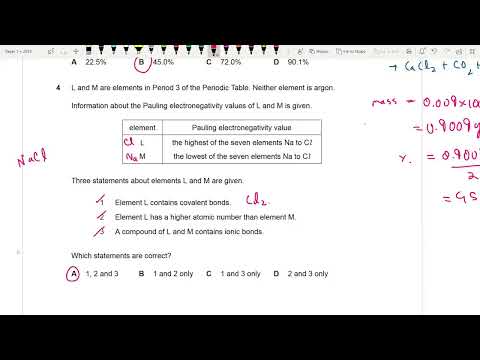 ▶ Whole paper
Video solution of the whole paper · by CAIE PAPERS SOLVED. Tap the picture to open it on YouTube.
Solutions follow the official Cambridge mark schemes. Videos are from other YouTube channels. Paper codes read component / series / year: M/J = May/June, O/N = October/November. Past-paper questions © UCLES, reproduced for classroom practice.