Q41 · 5090/11/M/J/23 Q13
Worked solution from the Human nutrition MCQ booklet.

Worked solution
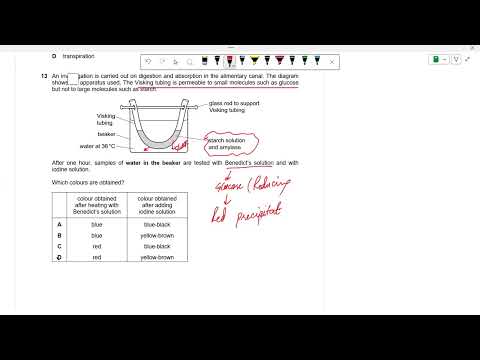
The question asks what colours the water in the beaker gives with Benedict's and iodine after one hour.
Inside the Visking tubing, amylase digests starch to maltose.
Maltose is a small molecule, so it passes through the tubing into the beaker. Hot Benedict's solution turns red with this reducing sugar.
Starch is a large molecule and cannot pass through the tubing. So the water has no starch, and iodine stays yellow-brown.
So the answer is D.
A and B are wrong because the Benedict's test would be red, not blue. A and C are wrong because iodine would only turn blue-black if starch got out into the beaker.
 ▶ Whole paper
Video solution of the whole paper · by Muhammad Haris Khan. Tap the picture to open it on YouTube.
Solutions follow the official Cambridge mark schemes. Videos are from other YouTube channels. Paper codes read component / series / year: M/J = May/June, O/N = October/November. Past-paper questions © UCLES, reproduced for classroom practice.