Q18 · 9700/12/F/M/21 Q22
Worked solution from the Nucleic acids and protein synthesis MCQ booklet.

Worked solution
The question asks which statements about complementary base pairing are correct.
1: Wrong. C–G has three hydrogen bonds, not two.
2: Right. Purines (A and G) have two rings and pyrimidines (C, T, U) have one ring, so they are different sizes.
3: Right. A–T has two hydrogen bonds and A–U also has two.
4: Right. Each pair is one purine with one pyrimidine, so every base pair has the same length and width.
So the answer is D.
The correct option is D (2, 3 and 4).
A, B and C all include statement 1, which is wrong.
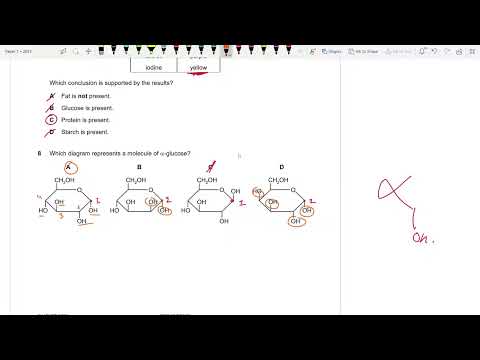 ▶ Whole paper
Video solution of the whole paper · by CAIE PAPERS SOLVED. Tap the picture to open it on YouTube.
Solutions follow the official Cambridge mark schemes. Videos are from other YouTube channels. Paper codes read component / series / year: M/J = May/June, O/N = October/November. Past-paper questions © UCLES, reproduced for classroom practice.