Q9 · 9708/43/O/N/22 Q7
Worked solution from the International economic issues Theory (Paper 4) booklet, Part 2 of 6.

Worked solution
Evaluate means: explain the statement, test both of its claims, and reach a judgement.
Write: under a fixed exchange rate the government and central bank hold the rate by buying and selling the domestic currency. Under a floating exchange rate the rate is set by market demand and supply.
Unemployment under a fixed rate: lowering interest rates would raise aggregate demand, output and employment, but it puts downward pressure on the exchange rate.
The central bank must then sell the foreign currency and buy its own, or raise interest rates again. Both undermine the policy to raise employment.
Unemployment under a floating rate: lower interest rates lead to a depreciation of the currency. Lower rates raise consumption and investment, and the lower currency value raises demand for exports.
So lower interest rate policies are more likely to be successful under a floating rate.
Evaluation: this works best for cyclical unemployment, not for structural or frictional unemployment, so the move will not solve all unemployment.
Inflation in the long run: a depreciating currency makes imports dearer and may cause cost-push inflation.
The central bank no longer has complete control over the money supply, which might also be inflationary in the long run.
Evaluation: how far inflation rises also depends on other factors, such as global expansion and rising commodity prices.
Conclusion: the move to floating rates may help to reduce cyclical unemployment in the short run and may raise inflation in the long run, but it will not solve all unemployment and inflation also depends on other factors, so the statement is only partly true.
This reaches Level 4: it explains fixed and floating rates, analyses the links with policies to reduce unemployment, discusses the long-run effect on inflation, and gives evaluative comments and a conclusion. [25]
Official mark scheme

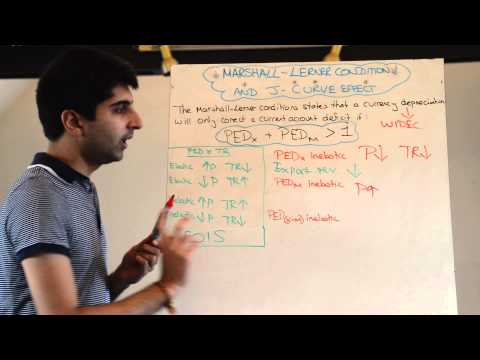 ▶ Topic lesson
A lesson on this topic · by EconplusDal. Tap the picture to open it on YouTube.
Solutions follow the official Cambridge mark schemes; marks are shown in grey. Videos are from other YouTube channels. Paper codes read component / series / year: M/J = May/June, O/N = October/November. Past-paper questions © UCLES, reproduced for classroom practice.