Q50 · 9700/42/M/J/20 Q5
Worked solution from the Inheritance Theory (Paper 4) booklet, Part 3 of 3.

Worked solution
(a)
Compare what each is made of; any three differences.
Elements: the transcription factor contains S, the promoter contains P. [1]
Molecule: the transcription factor is protein, the promoter is DNA. [1]
Monomers and bonds: amino acids joined by peptide bonds against nucleotides joined by phospho(di)ester bonds; or globular against double helix. [1]
(b)(i)
Explain why bioinformatics was used.
Write: the sequences (features) of the sites are already known. [1]
Write: the number of base pairs (quantity of data) to search is very large. [1]
(b)(ii)
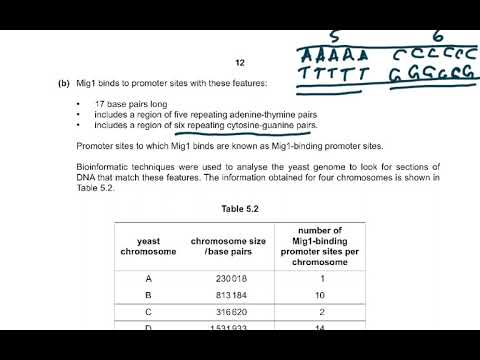
Look at the number of sites in Table 5.2.
Write: chromosome D, as it has the most (14) Mig1-binding promoter sites. [1]
(b)(iii)
The expected number is 10 (five genes, two copies in a diploid cell).
Write: Mig1 also regulates genes in other pathways. [1]
Write: there could be several copies of one or more of these five genes. [1]
(c)
Describe repression at the lac operon; any three points.
The regulatory gene (gene I) codes for a repressor protein. [1]
The repressor binds to the operator, which prevents RNA polymerase binding to the promoter. [1]
So the lac (structural) genes are not transcribed; the repressor only binds when lactose is absent. [1]
Official mark scheme

 ▶ Whole paper
Video solution of the whole paper · by Dr Saira Biology. Tap the picture to open it on YouTube.
Solutions follow the official Cambridge mark schemes; marks are shown in grey. Videos are from other YouTube channels. Paper codes read component / series / year: M/J = May/June, O/N = October/November. Past-paper questions © UCLES, reproduced for classroom practice.