Q62 · 0620/43/O/N/25 Q6
Worked solution from the Organic chemistry Theory (Paper 4) booklet, Part 7 of 7.

Worked solution
(a)
Divide each percentage by its Ar.
C: 50.00 ÷ 12 = 4.17; H: 5.56 ÷ 1 = 5.56; O: 44.44 ÷ 16 = 2.78 [1]
Divide all by the smallest (2.78): C = 1.5; H = 2; O = 1 [1]
Multiply by 2 to get whole numbers: C = 3; H = 4; O = 2
Write C3H4O2. [1]
(b)
The empirical formula CHO has Mr = 12 + 1 + 16 = 29. Divide: 116 ÷ 29 = 4.
Multiply every number in CHO by 4.
Write C4H4O4. [1]
(c)(i)
Acid + alcohol → ester + water.
Write water. [1]
(c)(ii)
The reaction needs a strong acid catalyst, such as sulfuric acid.
Write acid. [1]
(c)(iii)
Split the ester at the C(=O)–O link. The part CH3CH2COO– comes from the acid and has 3 carbons. The part CH2CH2CH2CH3 comes from the alcohol and has 4 carbons in a straight chain.
Carboxylic acid: write propanoic acid. [1]
Alcohol: write butan-1-ol. [1]
(d)(i)
The polymer chain has only C–C single bonds with no other link, and it comes from a monomer with a C=C double bond.
Write addition polymerisation. [1]
(d)(ii)
A molecular formula needs a fixed number of atoms.
Write that polymers are of indefinite length (the number of repeat units is not fixed). [1]
(d)(iii)
Each repeat unit has 2 carbon atoms in the chain. The part shown has 6 chain carbons.
6 ÷ 2 = 3
Write 3. [1]
(d)(iv)
Each repeat unit has two carbons, each with one CH3 and one H. So the monomer is but-2-ene, CH3CH=CHCH3.
Draw a C=C double bond between the two central carbons. [1]
Draw the full displayed formula of but-2-ene: each C of the double bond has one CH3 group (with all three H shown) and one H, with every bond drawn. [1]
(e)(i)
An amino acid has an amine group –NH2 and a carboxylic acid group –COOH on the same carbon.
Draw –NH2 fully displayed: N joined to the C with two H atoms on the N. [1]
Draw –COOH fully displayed: C=O and C–O–H, joined to the central C. [1]
(e)(ii)
An amide linkage is the –C(=O)–N(H)– link.
Draw a circle around one –C(=O)–N(H)– link, including the C, its =O, the N and its H. [1]
(e)(iii)
Natural polyamides made from amino acids are found in living things.
Write proteins. [1]
Official mark scheme

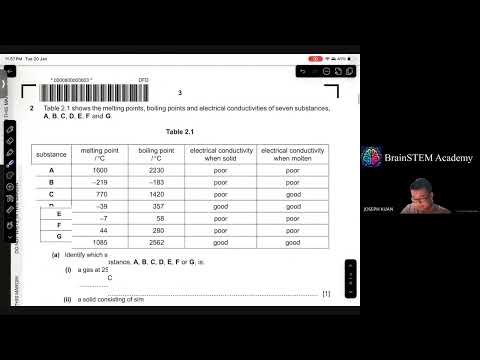 ▶ Whole paper
Video solution of the whole paper · by Teacher Joseph Kuan - IGCSE Chemistry Online Tutor. Tap the picture to open it on YouTube.
Solutions follow the official Cambridge mark schemes; marks are shown in grey. Videos are from other YouTube channels. Paper codes read component / series / year: M/J = May/June, O/N = October/November. Past-paper questions © UCLES, reproduced for classroom practice.