Q42 · 9708/21/O/N/20 Q4
Worked solution from the International economic issues Theory (Paper 2) booklet, Part 5 of 5.

Worked solution
(a)
The question asks how a subsidy to producers changes export revenue (export price × quantity exported). Draw the diagram first.
Diagram: draw a market diagram for the product. Label the vertical axis price (P) and the horizontal axis quantity (Q). Draw a downward-sloping demand curve D and an upward-sloping supply curve S meeting at the equilibrium point (P, Q). [1]
Draw a new supply curve S1 to the right of S (a subsidy shifts supply right). Mark the new equilibrium where S1 meets D, with a lower price P1 and a higher quantity Q1. [1]
Write: the government pays a subsidy to firms, which reduces their costs of production. [1]
So firms are willing to supply more output at any given price, so the supply curve shifts to the right (S to S1). [1]
The equilibrium price falls (P to P1) and the equilibrium quantity rises (Q to Q1), so the product is cheaper and more is available to export. [1]
The effect on export revenue depends on price elasticity of demand (PED): if foreign demand is price-elastic, the fall in price causes a bigger percentage rise in quantity demanded, so export revenue rises. [1]
If foreign demand is price-inelastic, the quantity rises by a smaller percentage than the price falls, so export revenue falls. [1]
It also depends on price elasticity of supply (PES): if supply is elastic, firms can raise output easily when the subsidy cuts costs, so more is exported and revenue is more likely to rise. If supply is inelastic, output rises only a little, so the gain in revenue is small. [1]
(b)
Discuss means: explain why supply-side policies might correct a current account deficit, why they might not, then decide.
Why they might: supply-side policies aim to raise the economy's productive capacity and lower costs, so exports become more price-competitive and imports are replaced by home output. [1]
Lower income tax and lower unemployment benefit increase the incentive to work, which can raise the supply of labour and output. [1]
More spending on education and training can raise labour productivity and the occupational mobility of labour, which lowers unit costs and so export prices. [1]
Privatisation and deregulation (for example fewer barriers to entry) can raise efficiency and bring in more firms and competition, so goods are cheaper and better. Lower costs and better quality raise exports and cut imports, reducing the deficit. [1]
Why they might not: lower taxes and benefits will not necessarily raise the supply of labour, especially if there are no jobs available. [1]
Education and training will not necessarily raise productivity, and the effect can take a long time to show. [1]
Reducing the power of trade unions will not necessarily cut the number of days lost to industrial action, and privatisation will not necessarily raise efficiency. [1]
Deregulation will not necessarily bring more firms into an industry, and better information on job vacancies will not necessarily correct the deficit, so the policies may not improve the current account. [1]
Evaluation: the policies work slowly, so they are unlikely to correct a deficit quickly and may be less effective than other policies in the short run. [1]
Whether they work depends on whether the policies actually raise output and lower costs, and on how price-elastic demand for exports and imports is. [1]
It also depends on the cause and size of the deficit: supply-side policies suit a deficit caused by uncompetitive, high-cost industries. [1]
Conclusion: supply-side policies can help correct a deficit in the long run, but because their effects are uncertain and slow they are not a reliable way on their own. [1]
Official mark scheme

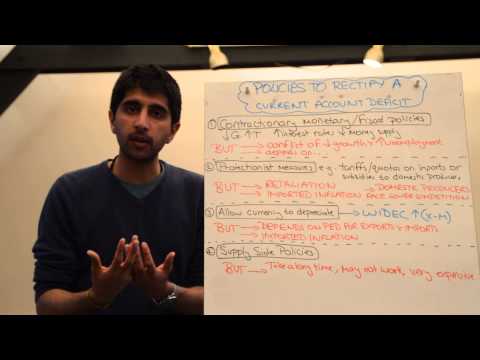 ▶ Topic lesson
A lesson on this topic · by EconplusDal. Tap the picture to open it on YouTube.
Solutions follow the official Cambridge mark schemes; marks are shown in grey. Videos are from other YouTube channels. Paper codes read component / series / year: M/J = May/June, O/N = October/November. Past-paper questions © UCLES, reproduced for classroom practice.