Q42 · 9701/43/M/J/24 Q3
Worked solution from the Chemistry of transition elements Theory (Paper 4) booklet, Part 2 of 4.

Worked solution
(a)
The residue is Li2CO3 (it gives CO2 with acid). The other gases are water vapour and one more gas from the ethanedioate.
Write Li2C2O4•H2O → Li2CO3 + H2O + CO. [1]
(b)
Both are Group 2, so look at the size of the cation. Smaller, more highly charged cations distort the anion more.
M1: write that CaC2O4 decomposes at the lower temperature, because Ca2+ has a smaller ionic radius (higher charge density). [1]
M2: write that it polarises (distorts) the C2O42− anion more. [1]
(c)
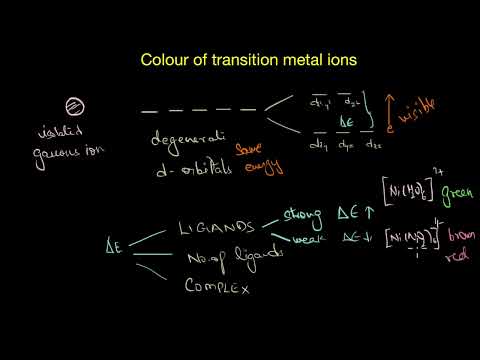
Think about d-orbitals in a complex and what light does.
M1: write that the d orbitals are split into different energy levels (d–d splitting). [1]
M2: write that an electron is promoted (excited) from a lower to a higher d orbital. [1]
M3: write that light of one frequency is absorbed and the colour seen is the complementary colour. [1]
(d)
Balance with 2 on the left: 2K3[Fe(C2O4)3] has 6 K and 2 Fe. The right side needs 2K2[Fe(C2O4)2] (4 K), then K2C2O4 (2 K).
Carbon check: left 12 C; right 8 + 2 + 2 from CO2 = 12 C, so 2CO2.
Write 2K3[Fe(C2O4)3] → 2K2[Fe(C2O4)2] + K2C2O4 + 2CO2. [1]
(e)
The three bidentate ligands make an octahedral complex. The two isomers are mirror images.
Draw one octahedral complex with three O–O ligands, each spanning two adjacent positions, using wedges and dashes. [1]
Draw the second as its non-superimposable mirror image. [1]
(f)
The buffer works because HC2O4− can accept H+ and can donate H+.
Added acid: HC2O4− + H+ → H2C2O4. [1]
Added alkali: HC2O4− + OH− → C2O42− + H2O. [1]
(g)
Reverse the half-equation with the more negative E (the fuel is oxidised) and add it to the O2 one. Make electrons equal: ×2 for the oxalate equation.
2C2O42− → 4CO2 + 4e−
Overall: 2C2O42− + O2(g) + 2H2O(l) → 4CO2(g) + 4OH−(aq) [1]
E°cell = 0.40 − (−0.59) = +0.99 V [1]
Official mark scheme

 ▶ Topic lesson
A lesson on this topic · by Khan Academy India - English. Tap the picture to open it on YouTube.
Solutions follow the official Cambridge mark schemes; marks are shown in grey. Videos are from other YouTube channels. Paper codes read component / series / year: M/J = May/June, O/N = October/November. Past-paper questions © UCLES, reproduced for classroom practice.