Q8 · 9700/43/M/J/21 Q5
Worked solution from the Photosynthesis Theory (Paper 4) booklet, Part 1 of 2.

Worked solution
(a)
Write any two differences.
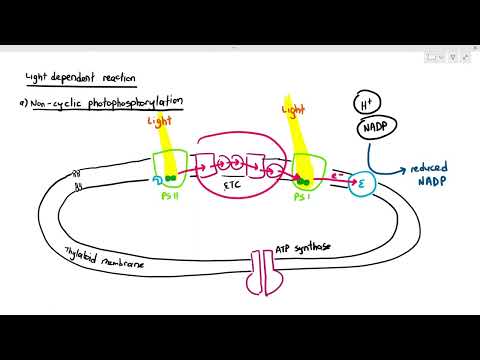
Cyclic uses only photosystem I (PSI); non-cyclic uses both PSI and PSII. [1]
Cyclic makes only ATP; non-cyclic makes ATP and reduced NADP. [1]
(Or: cyclic has no photolysis of water, while non-cyclic does. Only two of these three score.)
(b)(i)
Tubes 1 and 5 have no organism.
They are control (reference) tubes for comparison. [1]
(b)(ii)
CO2 makes the water acidic, so less CO2 means higher pH (blue) and more CO2 means lower pH (yellow).
Tube 2 (plant, light) turns blue: the plant does photosynthesis. [1]
It uses up CO2 in the Calvin cycle, so the pH rises. [1]
Tube 3 (snail) turns yellow: the snail does respiration. [1]
It makes CO2 (in the link reaction or Krebs cycle), so the pH falls. [1]
Tube 4 (plant and snail, light) stays green: both photosynthesis and respiration happen, so the CO2 made by the snail is used by the plant (or the oxygen from the plant is used by the snail). [1]
(b)(iii)
Tube 6 has the plant in the dark and turns yellow-green, a small fall in pH. Write any three.
In the dark there is no or less photosynthesis, so no or less CO2 is used. [1]
The plant still does respiration, which produces CO2. [1]
The plant's respiration rate is slower than the snail's (tube 7 is fully yellow), so there is only a slight decrease in pH. [1]
Official mark scheme

 ▶ Topic lesson
A lesson on this topic · by OtterBioTutor. Tap the picture to open it on YouTube.
Solutions follow the official Cambridge mark schemes; marks are shown in grey. Videos are from other YouTube channels. Paper codes read component / series / year: M/J = May/June, O/N = October/November. Past-paper questions © UCLES, reproduced for classroom practice.