Q18 · 9700/23/O/N/21 Q2
Worked solution from the Enzymes Theory (Paper 2) booklet, Part 2 of 2.

Worked solution
(a)
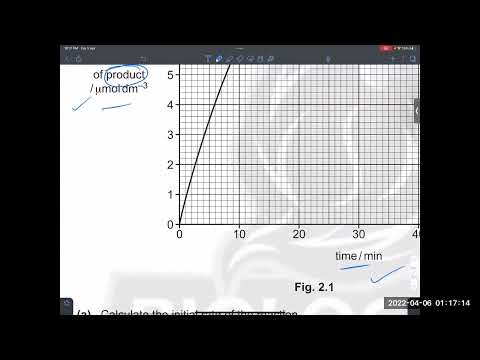
Use the straight part at the start of Fig. 2.1: the product reaches 6 μmol dm−3 at 10 min.
Initial rate = change in concentration ÷ time = (6 − 0) ÷ (10 − 0) = 0.6 [1]
Write the unit: μmol dm−3 min−1 (anything from 0.6 to 0.8 scores). [1]
(b)(i)
A competitive inhibitor blocks active sites. Write any two predictions:
The initial rate will be lower (slower). [1]
It will take longer to reach the plateau, but the final concentration of product will be the same (10 μmol dm−3). [1]
(b)(ii)
At 30 °C molecules have more kinetic energy. Write any two predictions:
The initial rate will be higher (faster). [1]
It will take a shorter time to reach the plateau, and the final concentration of product will be the same (10 μmol dm−3). [1]
(c)
Any two of these:
It allows a valid comparison of the enzymes' activities, because the initial rate is the fastest rate. [1]
In Fig. 2.1 the curve flattens, so a rate calculated over a longer time would vary; at the start substrate is in excess (not limiting) and product has not built up to affect the rate. [1]
Official mark scheme

 ▶ Whole paper
Video solution of the whole paper · by Dr. Awais Syed. Tap the picture to open it on YouTube.
Solutions follow the official Cambridge mark schemes; marks are shown in grey. Videos are from other YouTube channels. Paper codes read component / series / year: M/J = May/June, O/N = October/November. Past-paper questions © UCLES, reproduced for classroom practice.