Q20 · 9700/43/M/J/22 Q3
Worked solution from the Energy and respiration Theory (Paper 4) booklet, Part 2 of 2.

Worked solution
(a)
Name the two ways ATP is made from ADP and Pi.
Write: substrate-linked (substrate-level) phosphorylation. [1]
Write: oxidative phosphorylation (by chemiosmosis). [1]
(b)
Describe what NAD and FAD do, and explain why. Any six points.
Write: they are hydrogen / electron carriers. [1]
Write: in glycolysis NAD is reduced as triose phosphate is oxidised / dehydrogenated. [1]
Write: in the link reaction NAD is reduced as pyruvate is oxidised to make acetyl CoA. [1]
Write: in the Krebs cycle both NAD and FAD are reduced. [1]
Write: reduced NAD and FAD deliver hydrogen / electrons to the inner mitochondrial membrane (electron transport chain) for oxidative phosphorylation, making ATP. [1]
Write: this recycles NAD and FAD, so the earlier stages (for example, regenerating oxaloacetate in the Krebs cycle) can continue. [1]
(c)
A high ratio of acetyl CoA to CoA means plenty of acetyl CoA is waiting to be used.
Write: the inhibition controls / slows the rate of the link reaction (a form of end-product inhibition). [1]
Write: it allows the build-up of acetyl CoA to be used in the Krebs cycle, and the enzyme becomes active again when CoA increases. [1]
Official mark scheme

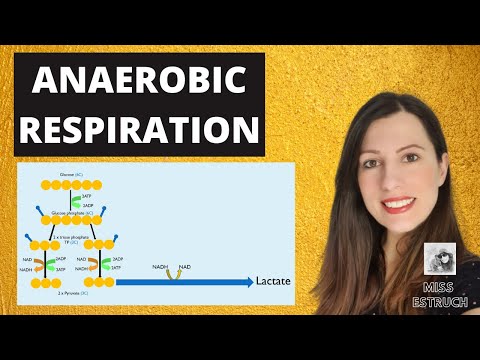 ▶ Topic lesson
A lesson on this topic · by Miss Estruch Biology. Tap the picture to open it on YouTube.
Solutions follow the official Cambridge mark schemes; marks are shown in grey. Videos are from other YouTube channels. Paper codes read component / series / year: M/J = May/June, O/N = October/November. Past-paper questions © UCLES, reproduced for classroom practice.