Q120 · 9706/31/M/J/23 Q2
Worked solution from the Financial accounting (A Level) Theory (Paper 3) booklet, Part 4 of 4.

Worked solution
(a)
Write any two comparisons:
Trend analysis (the same business over several years) [1]
Inter-company comparison (with a similar business, or an industry average) [1]
(b)(i)
Net assets = non-current assets + current assets − current liabilities − non-current liabilities.
Non-current assets = revenue ÷ non-current asset turnover = $825 000 ÷ 1.6 = $515 625 [1]
| Details | $ |
|---|---|
| Non-current assets | 515 625 |
| Inventory | 44 000 |
| Trade receivables | 76 400 |
| Trade payables | (32 900) |
| Cash at bank | 81 000 |
| Debenture | (100 000) |
| Net assets | 584 125 [1] |
(b)(ii)
Equity = net assets = $584 125.
Retained earnings = equity − ordinary share capital − share premium [1]
= $584 125 − $300 000 − $30 000 = $254 125 [1]
(b)(iii)
Retained earnings at 1 January = retained earnings at 31 December − profit for the year + dividends paid. First find the profit for the year (W1).
W1 Dividend yield = dividend per share ÷ market price, so market price = ($0.30 + $0.15) ÷ 4% = $11.25 [1]
Price / earnings ratio = market price ÷ earnings per share, so earnings per share = $11.25 ÷ 18 = $0.625 [1]
Profit for the year = $0.625 × 300 000 shares = $187 500 [1]
| Details | $ |
|---|---|
| Retained earnings at 31 December 2022 | 254 125 [1] |
| Profit for the year (W1) | (187 500) |
| Dividend paid (300 000 × $0.30) | 90 000 [1] |
| Retained earnings at 1 January 2022 | 156 625 [1] |
The interim dividend is the one paid in the year; the proposed final dividend is not deducted.
(c)(i)
Working capital cycle = inventory days + trade receivable days − trade payable days. Round each part up to the next whole day.
Trade receivable days = $76 400 ÷ $825 000 × 365 = 33.8 → 34 days [1]
Cost of sales = $825 000 × (1 − 48%) = $429 000 [1]
Opening inventory = $429 000 + $44 000 − $405 000 = $68 000; average inventory = ($44 000 + $68 000) ÷ 2 = $56 000 [1]
Inventory days = $56 000 ÷ $429 000 × 365 = 47.6 → 48 days [1]
Trade payable days = $32 900 ÷ $405 000 × 365 = 29.6 → 30 days [1]
Working capital cycle = 34 + 48 − 30 = 52 days [1]
(c)(ii)
Gearing = non-current liabilities ÷ (issued ordinary share capital + all reserves + non-current liabilities) × 100
= $100 000 ÷ ($100 000 + $300 000 + $30 000 + $254 125) [1]
= $100 000 ÷ $684 125 = 14.62% [1]
(d)
Give points for both views, then a decision. Any valid points are accepted.
Should be concerned (max 2): it takes a longer time to turn its working capital into cash. [1]
It may be holding too much inventory, or have poor credit control over receivables, or be paying payables too early. [1]
Should not be concerned (max 2): the difference is not material. [1]
The two companies may have different policies, and non-financial factors may affect the figures. [1]
Decision: write one view with a comment, for example that Z plc should be concerned, because its cycle of 52 days is 5 days longer than B plc's, so cash is tied up for longer. [1]
Official mark scheme

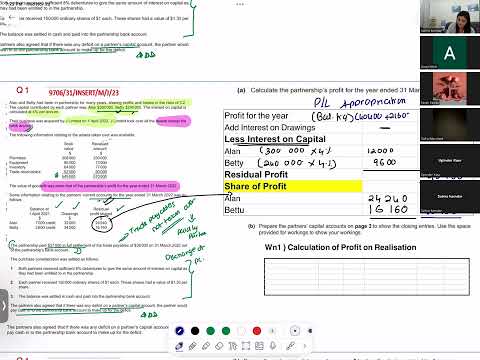 ▶ Whole paper
Video solution of the whole paper · by IGCSE / AS LEVEL / A LEVEL MATHS AND ACCOUNTS. Tap the picture to open it on YouTube.
Solutions follow the official Cambridge mark schemes; marks are shown in grey. Videos are from other YouTube channels. Paper codes read component / series / year: M/J = May/June, O/N = October/November. Past-paper questions © UCLES, reproduced for classroom practice.