Q22 · 9700/41/O/N/21 Q7
Worked solution from the Inheritance Theory (Paper 4) booklet, Part 2 of 3.

Worked solution
(a)
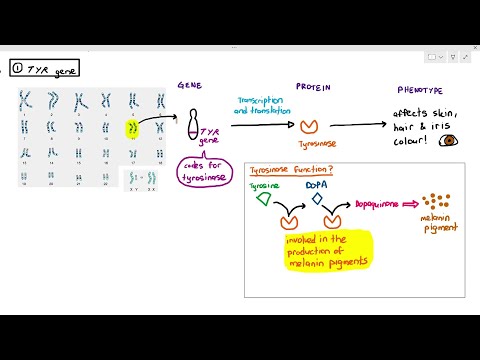
Explain how a gene mutation stops the enzyme working. Any four of these points.
A base (nucleotide) insertion, deletion or substitution changes the DNA. [1]
An insertion or deletion causes a frameshift (changed reading frame), which may create a stop codon. [1]
The primary structure (amino acid sequence) is different, so the folding (3D shape, tertiary structure) of the enzyme is different. [1]
The active site does not bind to (fit) the substrate (the complex molecules). [1]
(b)
The allele is X-linked, so write the alleles on the X chromosome.
Key: XH = normal allele, Xh = Hunter syndrome allele. [1]
Parental genotypes: normal male XHY × heterozygous normal female XHXh. [1]
Gametes: XH and Y from the male; XH and Xh from the female.
Offspring genotypes: XHXH, XHXh, XHY, XhY. [1]
Offspring phenotypes: normal female, normal (carrier) female, normal male, Hunter syndrome male. [1]
Probability of a child with Hunter syndrome = 1 out of 4 = 0.25 (25%, 1 in 4) [1]
Official mark scheme

 ▶ Topic lesson
A lesson on this topic · by OtterBioTutor. Tap the picture to open it on YouTube.
Solutions follow the official Cambridge mark schemes; marks are shown in grey. Videos are from other YouTube channels. Paper codes read component / series / year: M/J = May/June, O/N = October/November. Past-paper questions © UCLES, reproduced for classroom practice.