Q27 · 9706/32/O/N/21 Q2
Worked solution from the Financial accounting (A Level) Theory (Paper 3) booklet, Part 1 of 4.

Worked solution
(a)
Work out purchases, closing inventory at cost and sales, then the profit.
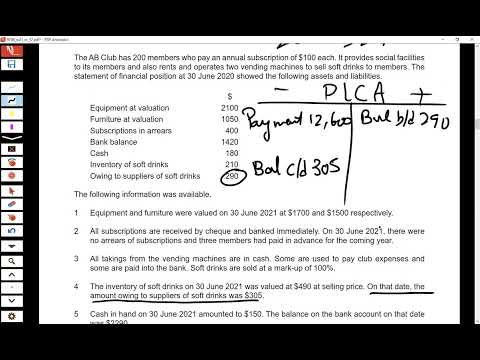
Purchases = payments 12 600 + owing at end 305 − owing at start 290 = $12 615
Closing inventory at cost = $490 ÷ 2 (mark-up 100%) = $245
Cost of sales = 210 + 12 615 − 245 = $12 580. With a 100% mark-up, sales = 12 580 × 2 = $25 160.
| Details | $ |
|---|---|
| Sales | 25 160 |
| Opening inventory | 210 |
| Purchases (12 600 + 305 − 290) | 12 615 [1] |
| 12 825 | |
| Closing inventory | (245) [1] |
| Cost of sales | (12 580) |
| Gross profit | 12 580 [1] |
| Rent of vending machines | (6 000) [1] |
| Profit from vending machines | 6 580 [1] |
(b)(i)
Subscriptions received = amount for the year + arrears collected + paid in advance
Subscriptions for the year = 200 members × $100 = $20 000 [1]
= 20 000 + (400 arrears + 3 × 100 in advance) [1]
= $20 700 [1]
(b)(ii)
Bank receipts = closing balance − opening balance + payments, then take off the subscriptions banked.
| Details | $ |
|---|---|
| Closing bank balance | 2 290 |
| Opening bank balance | (1 420) [1] |
| Bank payments | 36 460 [1] |
| Subscriptions banked | (20 700) [1] |
| Cash banked | 16 630 [1] |
(b)(iii)
Cash paid for club expenses = opening cash + takings − closing cash − cash banked
| Details | $ |
|---|---|
| Opening cash | 180 |
| Closing cash | (150) [1] |
| Sales (cash takings) | 25 160 [1] |
| Cash banked | (16 630) [1] |
| Club expenses paid by cash | 8 560 [1] |
(c)
Depreciation: equipment = 2 100 − 1 700 = $400. Furniture = 1 050 + 720 − 1 500 = $270.
AB Club: Income and expenditure account for the year ended 30 June 2021
| Details | $ |
|---|---|
| Subscriptions | 20 000 [1] |
| Profit from vending machines | 6 580 [1] |
| Total income | 26 580 |
| Rent | 12 000 |
| Club expenses (5 140 + 8 560) | 13 700 [1] |
| Depreciation of equipment | 400 [1] |
| Depreciation of furniture | 270 [1] |
| Total expenditure | (26 370) |
| Surplus of income over expenditure | 210 [1] |
(d)
Write the points for and against, then your decision.
A third machine means more drinks sold, so sales and profit could rise. [1]
But there is a limit to demand: will the members buy more drinks? [1]
(Other accepted points: the rent is a fixed cost that reduces profit; the machine could sell something different, such as snacks.)
Decision: state clearly either "rent" or "do not rent", and back it with the points above. [1]
Official mark scheme

 ▶ Whole paper
Video solution of the whole paper · by Muhammad Osama. Tap the picture to open it on YouTube.
Solutions follow the official Cambridge mark schemes; marks are shown in grey. Videos are from other YouTube channels. Paper codes read component / series / year: M/J = May/June, O/N = October/November. Past-paper questions © UCLES, reproduced for classroom practice.