Q29 · 0610/22/F/M/20 Q27
Worked solution from the Coordination and response MCQ booklet.

Worked solution
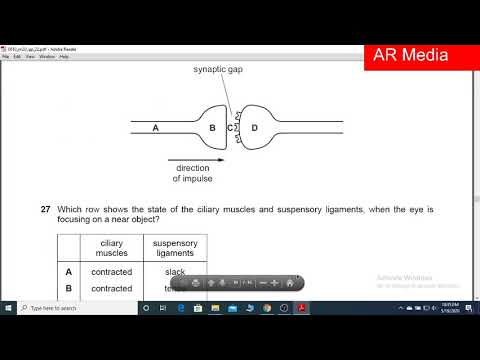
The question asks for the state of the ciliary muscles and suspensory ligaments when the eye focuses on a near object.
To see a near object, light rays must be bent more, so the lens must become thicker and more curved.
The ciliary muscles contract. This reduces the tension on the suspensory ligaments, so they go slack. The lens is no longer pulled flat and becomes fat.
So the answer is A.
B says the ligaments are tense, which happens when the ciliary muscles are relaxed. C and D say the ciliary muscles are relaxed, which is for focusing on distant objects.
 ▶ Whole paper
Video solution of the whole paper · by eduTV Online. Tap the picture to open it on YouTube.
Solutions follow the official Cambridge mark schemes. Videos are from other YouTube channels. Paper codes read component / series / year: M/J = May/June, O/N = October/November. Past-paper questions © UCLES, reproduced for classroom practice.