Q22 · 9609/32/M/J/23 Q5
Worked solution from the Business and its environment Theory (Paper 3) booklet, Part 1 of 2.

Worked solution
Answer
Plan: define sustainability, apply it to OV's mission, product and costs, then weigh the costs against the benefits and give a judgement.
Knowledge: sustainability means meeting the needs of the present without harming the ability of future generations to meet theirs. It links to corporate social responsibility (CSR), and it means OV must think about its environmental impact in every decision.
Application: OV's mission is to make quality food using sustainable methods. Its organic yogurt is more environmentally friendly, and it gives 5% of its profits to educational projects as part of its CSR. But a newspaper article, Destroying the Planet, says Greek yogurt makes acid whey that harms wildlife and farmland and uses a lot of fresh water. OV also sells fresh yogurt direct to the consumer.
Analysis (benefit): a sustainable approach enhances OV's brand image with health-conscious customers, which supports a premium price and a USP. This raises sales and profit, and gives OV more control over its pricing in a market with intense rivalry.
Analysis (cost): meeting the issues in the article has a cost. OV may have to stop selling acid whey to farmers, store it or pay for research and development into other uses. It may need to change direct delivery to cut its carbon footprint, and use more costly ingredients and energy-efficient equipment in the new factory. Higher costs reduce profit margins and profit.
Evaluation: the impact depends on the balance of costs and benefits, and on how competitors act. Given OV's mission statement, OV cannot afford to ignore the article: claiming to be sustainable while not acting that way risks a backlash, lost image and lost sales. Laws may also change, so acting before they do is wise.
Judgement: the growing importance of sustainability will increase OV's costs in the short run but, on balance, will help OV more than it harms it. Its mission, its organic image and its plant-based range fit the trend, so OV should deal with acid whey and water use now to protect its brand and its premium price.
This earns the top level for knowledge: the key term and how it affects OV are both developed. [2]
It earns the top level for application: the point is applied to OV's mission, product and the article more than once. [2]
It earns the top level for analysis: two or more links in the chain (cost, price, brand, sales, profit). [2]
It reaches the top level for evaluation: a developed judgement in context that balances costs and benefits for OV. [6]
Official mark scheme

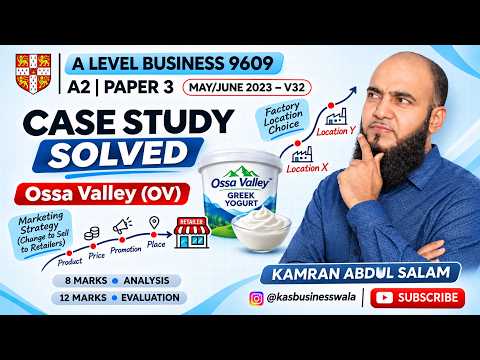 ▶ Whole paper
Video solution of the whole paper · by Kamran Abdul Salam. Tap the picture to open it on YouTube.
Solutions follow the official Cambridge mark schemes; marks are shown in grey. Videos are from other YouTube channels. Paper codes read component / series / year: M/J = May/June, O/N = October/November. Past-paper questions © UCLES, reproduced for classroom practice.