Q53 · 0620/43/O/N/25 Q2
Worked solution from the Atoms, elements and compounds Theory (Paper 4) booklet, Part 5 of 6.

Worked solution
(a)(i)
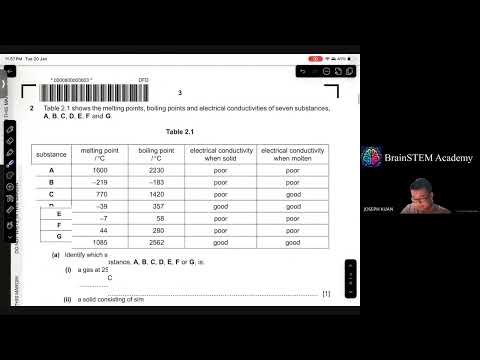
A gas at 25 °C has a boiling point below 25 °C. Only B (boiling point −183 °C) does.
Write B. [1]
(a)(ii)
A solid at 25 °C has a melting point above 25 °C. Simple molecules have low melting and boiling points and do not conduct. E melts at −7 °C so it is a liquid. F melts at 44 °C, so it is solid at 25 °C.
Write F. [1]
(a)(iii)
A metal conducts when solid. It is liquid at 25 °C if the melting point is below 25 °C and the boiling point is above it. D melts at −39 °C.
Write D. [1]
(b)(i)
Giant covalent substances have very high melting and boiling points and do not conduct when solid or molten (no ions or free electrons). A fits: 1600 °C and poor conductor.
Write substance A. [1]
Reason 1: high melting point and/or high boiling point. [1]
Reason 2: poor conductor of electricity when solid and when molten. [1]
(b)(ii)
Ionic compounds do not conduct when solid (ions fixed in place) but conduct when molten (ions free to move). C does this.
Write substance C. [1]
Reason: it conducts electricity only when molten (poor when solid). [1]
Official mark scheme

 ▶ Whole paper
Video solution of the whole paper · by Teacher Joseph Kuan - IGCSE Chemistry Online Tutor. Tap the picture to open it on YouTube.
Solutions follow the official Cambridge mark schemes; marks are shown in grey. Videos are from other YouTube channels. Paper codes read component / series / year: M/J = May/June, O/N = October/November. Past-paper questions © UCLES, reproduced for classroom practice.