Q8 · 9701/22/F/M/22 Q2
Worked solution from the The Periodic Table: chemical periodicity Theory (Paper 2) booklet, Part 2 of 3.

Worked solution
(a)(i)
Write: a reducing agent is a species that donates electrons. [1]
(a)(ii)
Na2O is a basic oxide and forms an alkali.
Na2O + H2O → 2NaOH. [1]
(b)(i)
Write: amphoteric means the oxide reacts with both acids and bases (shows both acidic and basic behaviour). [1]
(b)(ii)
Al2O3 + 2NaOH + 3H2O → 2NaAl(OH)4. [1]
(b)(iii)
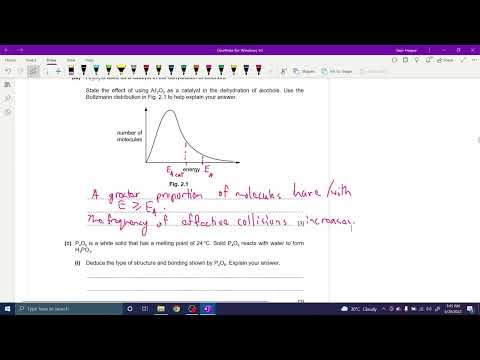
A catalyst gives a different route with a lower activation energy.
On the Boltzmann diagram, draw two vertical lines: EA and a lower EA,cat. [1]
A greater proportion of molecules has energy ≥ EA with the catalyst. [1]
So the frequency of effective collisions increases, and the rate goes up. [1]
(c)(i)
P4O6 melts at only 24 °C, so it is a small molecule.
The structure is simple molecular, because it has a low melting point. [1]
The bonding is covalent, because it is hydrolysed (reacts with water to make an acid). [1]
(c)(ii)
In H3PO3: 3(+1) + P + 3(−2) = 0, so P = +3.
Oxidation number of P is +3. [1]
(c)(iii)
ΔHf[P4O10] = ΔHf[P4O6] + ΔHr
−3012 = ΔHf[P4O6] + (−1372)
ΔHf[P4O6] = −3012 + 1372 = −1640 kJ mol−1. [1]
(c)(iv)
P4O10 + 6H2O → 4H3PO4. [1]
(d)(i)
NO2 is used up in step 1 and makes NO. Oxygen turns NO back into NO2.
NO + ½O2 → NO2. [1]
(d)(ii)
The product that contributes to photochemical smog is peroxyacetyl nitrate (PAN). [1]
(d)(iii)
From the graph, it is colder at 20 km (about −60 °C) than at 50 km (about 0 °C). The forward reaction is exothermic.
At 20 km the position of equilibrium is further to the right. [1]
Because the forward reaction is exothermic and the temperature is lower at 20 km, the equilibrium shifts in the exothermic direction. [1]
Official mark scheme

 ▶ Whole paper
Video solution of the whole paper · by CAIE PAPERS SOLVED. Tap the picture to open it on YouTube.
Solutions follow the official Cambridge mark schemes; marks are shown in grey. Videos are from other YouTube channels. Paper codes read component / series / year: M/J = May/June, O/N = October/November. Past-paper questions © UCLES, reproduced for classroom practice.