Q9 · 2281/22/O/N/23 Q2
Worked solution from the International trade and globalisation Theory (Paper 2) booklet, Part 2 of 4.

Worked solution
(a)
Write: a capital good is a good used to produce other goods and services (a human-made good used for production). [1]
Example: a machine. [1]
(b)
Write two reasons, each with an explanation:
Low inflation makes the country's products internationally competitive, [1]
so it sells more exports and buys fewer imports. [1]
It creates greater certainty, [1]
which encourages investment and attracts multinational companies. [1]
(Also accepted: it keeps cost increases low, or it increases confidence and so demand.)
(c)
Analyse means: give each step of the chain of reasoning and link them. Use two or three ways:
Remove tariffs, [1]
which reduces the price of imports; firms then face lower costs of production and can compete. [1]
Remove quotas (or raise the limit) and remove bans or embargoes, [1]
which increases the quantity of imports allowed. [1]
Remove subsidies, [1]
so firms' products are not artificially cheap. [1]
(Other countries may then remove their protectionism too, so exports can be sold without restrictions. Deregulation, less bureaucracy and ending voluntary export restraints are also accepted.)
(d)
Discuss means: explain why it might happen, explain why it might not, then decide.
Why it might: there is high global demand for diamonds, [1]
and mining can improve the current account of the balance of payments. [1]
It creates employment, both skilled and unskilled, [1]
increases output and economic growth, and may increase tax revenue. [1]
Why it might not: demand will fall in a recession, [1]
and the price may fluctuate; there may be competition and accidents. [1]
It can create external costs such as pollution, and if an MNC mines it, profit may be sent to the home country. [1]
Supply may be depleted, the price may rise in future so it may be better to conserve diamonds, and mining may not be a large part of GDP. [1]
Conclusion: it depends on whether the benefits outweigh the costs.
Official mark scheme

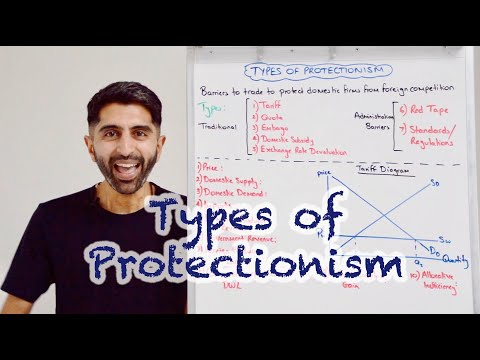 ▶ Topic lesson
A lesson on this topic · by EconplusDal. Tap the picture to open it on YouTube.
Solutions follow the official Cambridge mark schemes; marks are shown in grey. Videos are from other YouTube channels. Paper codes read component / series / year: M/J = May/June, O/N = October/November. Past-paper questions © UCLES, reproduced for classroom practice.