Q1 · 9700/42/F/M/20 Q7
Worked solution from the Photosynthesis Theory (Paper 4) booklet, Part 1 of 2.

Worked solution
(a)
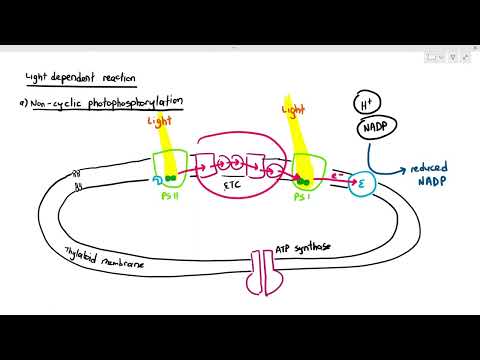
Site 1 takes in water and light and gives out A, B and C, so it is the light dependent stage. Site 2 is the light independent stage (Calvin cycle).
Write: site 1 = thylakoid (membrane) or granum. [1]
Write: site 2 = stroma. [1]
(b)
A leaves site 1 after water is split (photolysis), so A is oxygen.
B and C go from the light dependent stage to the Calvin cycle: they are reduced NADP and ATP, in either order, but B and C must be different.
D enters the Calvin cycle and is used to make triose phosphate, so D is carbon dioxide.
Write: A = oxygen, B = reduced NADP (or ATP), C = ATP (or reduced NADP), D = carbon dioxide. Four correct = [3]; three correct = 2; one or two correct = 1. [3]
(c)
Triose phosphate can be made into carbohydrates, lipids and amino acids. Write any three different functions, each with an example. Each pair scores one mark.
Cell wall production or support, with cellulose. [1]
Respiration, with a named monosaccharide or disaccharide (for example glucose or sucrose). [1]
Energy store, with starch or lipids (fatty acids). [1]
Other pairs that score: protein synthesis with amino acids; storing genetic information with nucleic acids (nucleotides); lipids used in the cell surface membrane. Only three pairs are needed.
Official mark scheme

 ▶ Topic lesson
A lesson on this topic · by OtterBioTutor. Tap the picture to open it on YouTube.
Solutions follow the official Cambridge mark schemes; marks are shown in grey. Videos are from other YouTube channels. Paper codes read component / series / year: M/J = May/June, O/N = October/November. Past-paper questions © UCLES, reproduced for classroom practice.