Q18 · 9701/13/M/J/21 Q10
Worked solution from the Equilibria MCQ booklet.

Worked solution
The mixture starts with N2 2.00 mol, H2 6.00 mol and NH3 2.40 mol. At equilibrium N2 is 2.32 mol, which is more than at the start.
So the reaction went backwards: NH3 broke down. N2 rose by 2.32 − 2.00 = 0.32 mol.
Ratio N2 : H2 : NH3 = 1 : 3 : 2. H2 rises by 3 × 0.32 = 0.96 mol, so H2 = 6.00 + 0.96 = 6.96 mol.
NH3 falls by 2 × 0.32 = 0.64 mol, so NH3 = 2.40 − 0.64 = 1.76 mol.
The volume is 1 dm3, so these are concentrations. Kc = [NH3]2 / ([N2][H2]3) = (1.76)2 / ((2.32)(6.96)3)
So the answer is A.
B uses 6.32 for H2, and C uses 2.08 for NH3 and 6.32 for H2. These do not follow the 1 : 3 : 2 ratio, because H2 must rise by 0.96, not by 0.32. D uses the starting amounts of NH3 (2.40) and H2 (6.00), not the equilibrium amounts.
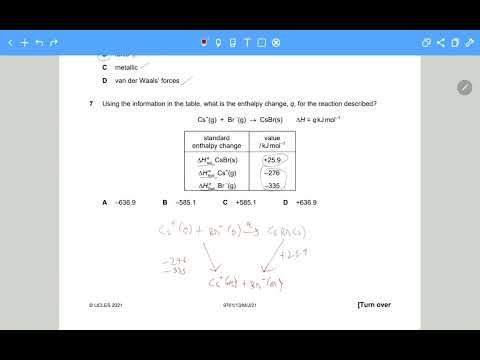 ▶ Whole paper
Video solution of the whole paper · by A-Level Chemistry and Physics. Tap the picture to open it on YouTube.
Solutions follow the official Cambridge mark schemes. Videos are from other YouTube channels. Paper codes read component / series / year: M/J = May/June, O/N = October/November. Past-paper questions © UCLES, reproduced for classroom practice.