Q16 · 5090/22/O/N/25 Q5
Worked solution from the Inheritance Theory (Paper 2) booklet, Part 3 of 4.

Worked solution
(a)(i)
The top pale yellow layer is the liquid part of blood: write plasma. [1]
Most of the plasma is water (the 91%). [1]
Solutes are dissolved substances. Write any three of these: glucose, amino acids, urea, mineral ions (a named mineral such as sodium), vitamins (a named vitamin), fatty acids / glycerol. [3]
(a)(ii)
Any two of these points:
Red blood cells contain haemoglobin. [1]
They are densely packed. [1]
Also credited (no extra mark once the limit is reached): Haemoglobin contains iron.
Also credited (no extra mark once the limit is reached): They have less water (solvent) in them.
Also credited (no extra mark once the limit is reached): The solutes increase the density.
(b)
Blood group A: IAIA and IAIO. [1]
Blood group B: IBIB and IBIO. [1]
Blood group AB: IAIB. [1]
Blood group O: IOIO. [1]
(c)(i)
The mother is IOIO, so she passes on IO. The fetus is group B, so it got IB from its father.
Write: IBIO. [1]
(c)(ii)
Any three of these points:
The fetus is separated from the mother by the placenta. [1]
The fetus has a separate blood stream from the mother. [1]
The antibodies are too big. [1]
Also credited (no extra mark once the limit is reached): They cannot pass across the placenta / through capillary walls.
Official mark scheme

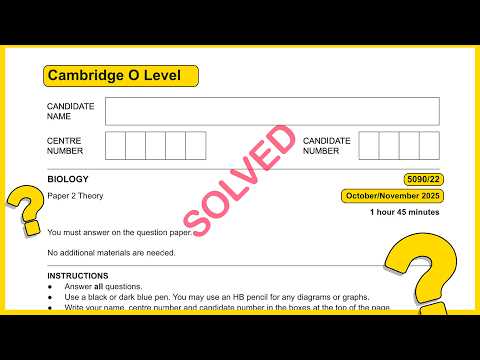 ▶ Whole paper
Video solution of the whole paper · by Alpha Learning. Tap the picture to open it on YouTube.
Solutions follow the official Cambridge mark schemes; marks are shown in grey. Videos are from other YouTube channels. Paper codes read component / series / year: M/J = May/June, O/N = October/November. Past-paper questions © UCLES, reproduced for classroom practice.