Q7 · 9708/42/F/M/22 Q7
Worked solution from the International economic issues Theory (Paper 4) booklet, Part 2 of 6.

Worked solution
(a)
Consider means: set out the circular flow, then work out how far a fall in the interest rate changes output and employment, with comments on how big the effect is.
Draw a three-sector circular flow diagram. Draw a box for households and a box for firms, with arrows between them: income (wages, rent, interest, profit) flowing from firms to households, and consumer spending flowing from households to firms. Add a financial sector box and a government box, and a box for the rest of the world.
Withdrawals (leakages) leave the flow: savings (S), taxes (T) and imports (M). Label them clearly by the arrows leaving households. Injections enter the flow: investment (I), government spending (G) and exports (X). Label them clearly by the arrows entering firms.
Write: the economy is in equilibrium where injections = withdrawals (I + G + X = S + T + M). This fixes the equilibrium level of income, output and employment. Mark the full employment level of income on the diagram.
Write: more spending means more output is demanded, so firms produce more and take on more workers. Spending, output, income and employment are linked in the flow.
Withdrawals: a fall in the rate of interest makes saving less rewarding, so savings fall and households spend more. Higher consumer spending raises expenditure, output and employment.
Injections: a lower rate of interest makes borrowing cheaper, so investment rises. Investment is an injection, so expenditure, output and employment rise.
Evaluation: the overall effect also depends on the multiplier. If the marginal propensity to save falls a lot, the multiplier is bigger and the rise in output and employment is substantial.
Evaluation: the rise in investment depends on the interest elasticity of investment (how much investment responds to the rate) and on the confidence of investors. If confidence is low, investment may hardly change.
Evaluation: it also depends on where the economy is now. If there is a lot of spare capacity (it is well below full employment), output and employment will rise a lot.
Conclusion: a fall in the rate of interest will probably raise output and employment by reducing saving and raising investment, but the size of the effect depends on the multiplier, investor confidence and spare capacity.
This reaches Level 4: it uses circular flow theory to analyse expenditure, income, output and employment, with an accurate diagram, one withdrawal and one injection considered, evaluative comments and a conclusion. [12]
(b)
Discuss means: explain why there might be a conflict, explain why there might not, then decide.
Write: with a fixed exchange rate, the government keeps the currency at a set value, with the central bank intervening in the foreign exchange market. If the currency is under downward pressure (a balance of payments deficit), the central bank uses its reserves of foreign currency to buy the domestic currency. If there is a surplus, it sells domestic currency in exchange for foreign currency. Fixing the rate at a lower level is a devaluation; at a higher level it is a revaluation.
With a fixed rate, the main tools of monetary policy are changes in interest rates and in the money supply. To reduce inflation, the government can raise interest rates to cut aggregate demand.
Why there is likely to be a conflict: higher interest rates attract short-term capital inflows, which put upward pressure on the domestic currency.
To hold the fixed rate, the central bank must sell domestic currency for foreign currency. This increases the money supply, which makes it harder to reduce inflation. So the two aims conflict.
Why there might not be a conflict: the government could use supply side policies instead, which can reduce inflation without much effect on the balance of payments.
But such policies may still make exports more competitive, which can again create problems for keeping the rate fixed.
Conclusion: there is likely to be a conflict when monetary policy is used against inflation under a fixed rate. The problem can be avoided by using other approaches, such as supply side policies.
This reaches Level 4: it explains fixed exchange rates and how a government and central bank achieve them, explains alternative monetary policies, links anti-inflation policies to the exchange rate and identifies the conflict, with a conclusion considering approaches that avoid it. [13]
Official mark scheme

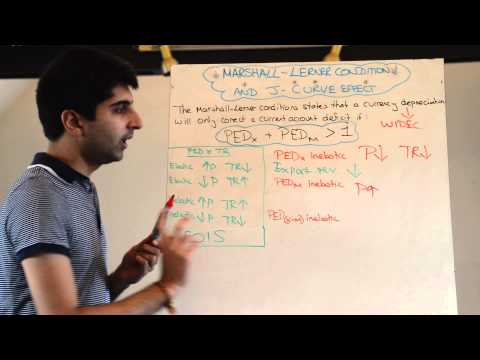 ▶ Topic lesson
A lesson on this topic · by EconplusDal. Tap the picture to open it on YouTube.
Solutions follow the official Cambridge mark schemes; marks are shown in grey. Videos are from other YouTube channels. Paper codes read component / series / year: M/J = May/June, O/N = October/November. Past-paper questions © UCLES, reproduced for classroom practice.