Q4 · 9700/41/M/J/20 Q6
Worked solution from the Energy and respiration Theory (Paper 4) booklet, Part 2 of 2.

Worked solution
(a)(i)
Pathway 2 makes lactate and does not use oxygen.
Write: anaerobic conditions (no or little oxygen). [1]
(a)(ii)
Pathway 1 is the link reaction: pyruvate becomes acetyl CoA, reduced NAD forms, and a gas is lost.
Write: carbon dioxide. [1]
(a)(iii)
Write: dehydrogenation (hydrogen removed, so NAD is reduced). [1]
Write: decarboxylation (carbon dioxide removed, shown by X). [1]
(a)(iv)
Pathway 1 happens in mitochondria, so choose a cell without them.
Write: red blood cell (erythrocyte). [1]
Reason: it has no mitochondria. [1]
(a)(v)
Write: substrate-linked phosphorylation. [1]
(b)(i)
Write: RQ = volume of carbon dioxide produced ÷ volume of oxygen consumed. [1]
This is measured per unit time. [1]
(b)(ii)
An RQ of 0.7 means lipids (fatty acids) are being respired by a hummingbird that has not fed. [1]
An RQ of 1.0 means sugar (carbohydrate) is being respired after feeding. [1]
(b)(iii)
Read Fig. 6.3: hummingbird = 95%, human = 32%.
Working: 95 ÷ 32 [1]
= 2.97 (times greater) [1]
(b)(iv)
Write any two of these:
The substrate is immediately available to muscle cells. [1]
There is no need to break down glycogen or other energy stores. [1]
Other points that score: glycogen stays available as a substrate between feeds; it cannot carry large stores because it must be light to fly.
Official mark scheme

 ▶ Topic lesson
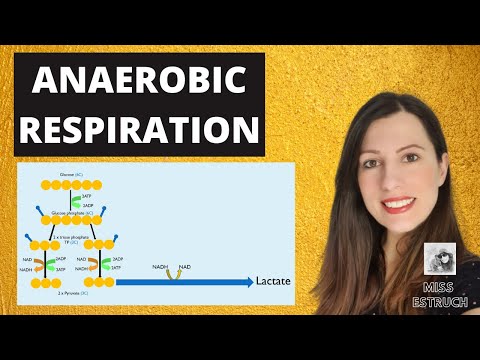
A lesson on this topic · by Miss Estruch Biology. Tap the picture to open it on YouTube.
Solutions follow the official Cambridge mark schemes; marks are shown in grey. Videos are from other YouTube channels. Paper codes read component / series / year: M/J = May/June, O/N = October/November. Past-paper questions © UCLES, reproduced for classroom practice.