Q9 · 5070/21/O/N/23 Q4
Worked solution from the Electrochemistry Theory (Paper 2) booklet, Part 1 of 2.

Worked solution
(a)
Concentrated aqueous calcium bromide has Ca2+, Br−, H+ and OH−. Calcium is more reactive than hydrogen, so hydrogen forms at the cathode. Bromide is concentrated, so it is discharged at the anode.
Anode: write bromine. [1]
Cathode: write hydrogen. [1]
(b)
Molten calcium bromide has only Ca2+ and Br− ions. Anode reactions lose electrons. Cathode reactions gain electrons.
Anode: 2Br− → Br2 + 2e− [1]
Cathode: Ca2+ + 2e− → Ca [1]
(c)
Add silver nitrate to the bromide solution. Acidify it first with dilute nitric acid.
Test: write add (acidified) silver nitrate. [1]
Observation: write a cream precipitate. [1]
(d)(i)
A reducing agent gives electrons away.
Write calcium gives electrons to the zinc ions (electrons are transferred from calcium to zinc ions). [1]
(d)(ii)
For a simple ion, the oxidation number is the same as the charge.
Write +2. [1]
(e)
Sulfur has 6 outer electrons and needs 2 more. Each bromine has 7 outer electrons and needs 1 more. So sulfur makes one single bond to each bromine.
Draw one shared pair of electrons (one dot and one cross) between S and each Br. [1]
Draw 4 non-bonding electrons (two lone pairs) on S, and 6 non-bonding electrons (three lone pairs) on each Br. [1]
Official mark scheme

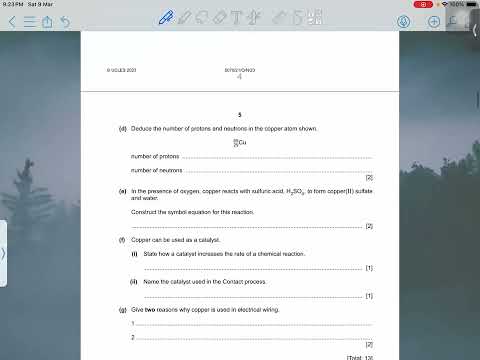 ▶ Whole paper
Video solution of the whole paper · by Dr Sajjad Haider. Tap the picture to open it on YouTube.
Solutions follow the official Cambridge mark schemes; marks are shown in grey. Videos are from other YouTube channels. Paper codes read component / series / year: M/J = May/June, O/N = October/November. Past-paper questions © UCLES, reproduced for classroom practice.