Q10 · 9701/42/F/M/22 Q3
Worked solution from the Chemistry of transition elements Theory (Paper 4) booklet, Part 1 of 4.

Worked solution
(a)(i)
Write: a d-block element that forms one or more stable ions with an incomplete d subshell. [1]
(a)(ii)
Write any two: variable oxidation states, act as catalysts, form complex ions, form coloured compounds. [1]
(b)(i)
In TiO2+, Ti is +4 (O is 2−, overall 2+).
Write: Ti in TiO2+ is in the +4 state, so it has no d electrons (d0). [1]
So no electron can be promoted and no visible light is absorbed. [1]
(b)(ii)
Ti has 22 electrons. Ti3+ has 19. The 4s electrons go first, then one 3d.
1s2 2s2 2p6 3s2 3p6 3d1 [1]
(b)(iii)
Ti goes from +4 to +3 and Zn goes from 0 to +2. Two Ti per Zn.
Write: 2TiO2+ + 4H+ + Zn → 2Ti3+ + 2H2O + Zn2+ [1]
(c)(i)
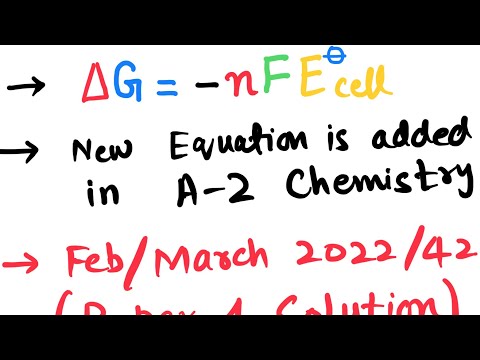
Use ΔG = −nEcellF. The equation has 4 electrons, so n = 4. [1]
Ecell = −436100 / (−4 × 96500) = 1.13 V [1]
Ecell = E(O2/H2O) − E(TiO2+/Ti3+) so E(TiO2+/Ti3+) = 1.23 − 1.13 = +0.10 V [1]
(c)(ii)
Write: Ti3+ has empty (vacant) d orbitals that can accept a lone pair from a ligand to form dative bonds. [1]
(c)(iii)
The complexed Ti(III) does not react with O2, so the reaction is not feasible.
Write: the E⦵ of this half-cell must be greater than +1.23 V (E⦵ of the O2/H+ half-cell), as Ecell would be negative. [1]
(d)(i)
Write: the number of coordinate (dative) bonds formed by the metal atom or ion. [1]
(d)(ii)
Six HF supply six F−. TiO2 gives up its two O as water.
Write: TiO2 + 6HF → TiF62− + 2H2O + 2H+ [1]
(d)(iii)
Write: a species with two lone pairs (of electrons). [1]
That forms two dative (coordinate) bonds to a central metal atom or ion. [1]
(d)(iv)
Stereoisomer 1 is a cis form (two Cl next to each other). The three isomers are one trans and a cis pair that are mirror images.
Draw stereoisomer 2 as the mirror image of isomer 1 (the cis form reflected). [1]
Draw stereoisomer 3 as the trans isomer: the two Cl on opposite sides (one up and one down) with the two acac rings around the middle. [1]
(d)(v)
Think about whether the bond dipoles cancel.
Write: stereoisomer 1 and the cis isomer you drew (stereoisomer 2) are polar. [1]
The dipoles (partial charges) do not cancel in the cis isomers. In the trans isomer, the dipoles point in opposite directions and do cancel. [1]
Official mark scheme

 ▶ Whole paper
Video solution of the whole paper · by ChemBridge. Tap the picture to open it on YouTube.
Solutions follow the official Cambridge mark schemes; marks are shown in grey. Videos are from other YouTube channels. Paper codes read component / series / year: M/J = May/June, O/N = October/November. Past-paper questions © UCLES, reproduced for classroom practice.