Q6 · 9700/42/O/N/20 Q1
Worked solution from the Photosynthesis Theory (Paper 4) booklet, Part 1 of 2.

Worked solution
(a)
A is the store of starch: draw a label line to a starch grain (the pale oval or large rounded area inside the chloroplast). [1]
B is the site of the Calvin cycle: draw a label line to the stroma (the grey background between the membranes). [1]
(b)(i)
C is a stack of disc-shaped membranes.
Write: granum (grana), a stack of thylakoids. [1]
(b)(ii)
Write any four of these points.
It is made of thylakoids, which are flattened membrane sacs. [1]
The membranes form a large surface area. [1]
This holds many pigments or photosystems (light-harvesting clusters) for the absorption of light energy. [1]
So there is room for a large number of enzymes, electron transport chains or ATP synthase, for the light dependent stage (photophosphorylation). [1]
(c)(i)
At high temperatures oxygen combines with rubisco (RuBP) instead of carbon dioxide, which is photorespiration. [1]
So less carbon dioxide combines with RuBP, meaning less carbon fixation. [1]
(c)(ii)
Read Fig. 1.2: carbon dioxide fell from about 1000 ppm 40 million years ago to about 500 ppm 30 million years ago, then to about 280 ppm by 20 million years ago, and stayed low after that.
Photosynthesis by C3 plants was using up carbon dioxide. [1]
The fall in carbon dioxide (or rise in oxygen) made a high oxygen to carbon dioxide ratio, so rubisco reacted more with oxygen. [1]
C4 plants had a selective advantage because oxygen acted as a selection pressure. [1]
Any three of these points.
Official mark scheme

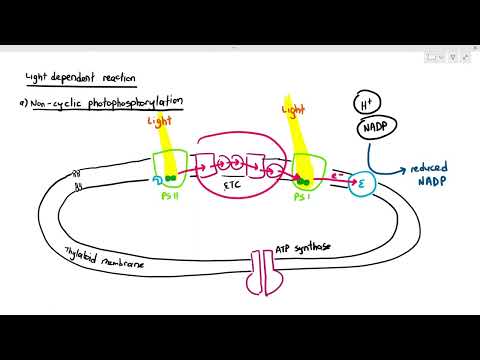 ▶ Topic lesson
A lesson on this topic · by OtterBioTutor. Tap the picture to open it on YouTube.
Solutions follow the official Cambridge mark schemes; marks are shown in grey. Videos are from other YouTube channels. Paper codes read component / series / year: M/J = May/June, O/N = October/November. Past-paper questions © UCLES, reproduced for classroom practice.