Q19 · 5090/22/O/N/24 Q4
Worked solution from the Coordination and control Theory (Paper 2) booklet, Part 2 of 6.

Worked solution
(a)(i)
Look at the graph: the lens starts most curved, then becomes least curved, then ends part-way curved.
A near object (the book) needs a most curved lens. A distant object (the bird high in the sky) needs a least curved lens. A clock on a wall is at a middle distance, so the lens is part-way curved.
Write: P → R → Q [1]
(a)(ii)
At H the lens is getting thinner, so the eye is changing to look at a distant object.
Write: the ciliary muscles. [1]
The ciliary muscles relax (so they get longer / less tight). [1]
The suspensory ligaments. [1]
The suspensory ligaments tighten (are pulled tight / under tension), which pulls the lens flat. [1]
(b)(i)
The black circle in the middle of the eye is the pupil. [1]
The coloured ring around it is the iris. [1]
(b)(ii)
In bright light the pupil gets smaller, so draw a small black circle (a much smaller pupil than in Fig. 4.2) in the centre of the iris. [1]
(b)(iii)
The change is fast and automatic, so write: reflex (action). [1]
(b)(iv)
Any two of these:
It protects the retina (the light receptors, rods and cones) from damage by too much bright light. [1]
It happens rapidly, so the damage is stopped quickly. [1]
Official mark scheme

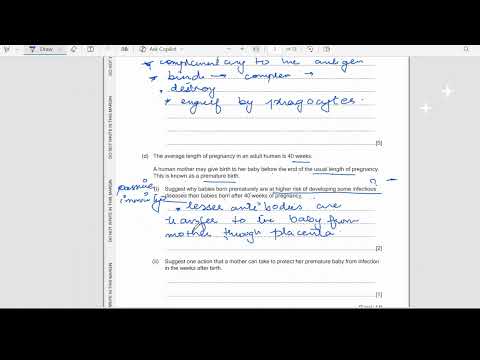 ▶ Whole paper
Video solution of the whole paper · by Learn with Miss Sehrish. Tap the picture to open it on YouTube.
Solutions follow the official Cambridge mark schemes; marks are shown in grey. Videos are from other YouTube channels. Paper codes read component / series / year: M/J = May/June, O/N = October/November. Past-paper questions © UCLES, reproduced for classroom practice.