Q20 · 9708/21/M/J/22 Q4
Worked solution from the International economic issues Theory (Paper 2) booklet, Part 2 of 5.

Worked solution
(a)
A fixed exchange rate is a rate set by the government or central bank. [1]
It is therefore not determined by demand and supply in the foreign exchange market. [1]
Difficulty 1: the government needs enough reserves of foreign currency to buy its own currency and keep the rate fixed. [1]
If reserves run out (for example when there is a lot of selling of the currency), the government cannot defend the rate. [1]
The central bank must keep buying its currency (to raise the rate) or selling it (to lower the rate), which uses up reserves. [1]
Difficulty 2: the government may have to change interest rates to hold the rate, for example raising them to raise the exchange rate. [1]
This can conflict with other economic aims: higher interest rates are not suitable when there is high unemployment, because they reduce spending and investment. [1]
So the government loses freedom to use interest rates for other policies. [1]
(b)
Discuss means: analyse both methods, then judge whether export subsidies are always better.
Advantages of export subsidies: a subsidy lowers firms' costs and prices, so they can undercut foreign competitors. [1]
They are hard for the WTO to deal with because they are not an obvious (overt) form of protection. [1]
Disadvantages of export subsidies: they have an opportunity cost, because the money could have been spent on other things by the government. [1]
Industries may become dependent on the subsidy instead of becoming more competitive. [1]
Advantages of tariffs: a tariff is a tax on imports, so imports become dearer and less competitive. [1]
If demand for imports is price-elastic, the quantity imported falls by a larger percentage, and the government also gains tax revenue. [1]
Disadvantages of tariffs: they will not work if demand for imports is price-inelastic, because people keep buying imports at the higher price. [1]
They may lead to retaliation by other countries. [1]
Evaluation: export subsidies are not always better. They help home firms sell abroad but cost the government money, while tariffs raise revenue but may bring retaliation. [1]
It depends on the PED of the products, on whether the government can afford the subsidies, and on how likely other countries are to retaliate. [2]
Conclusion: neither method is better in every case; the better one depends on these conditions. [1]
Official mark scheme

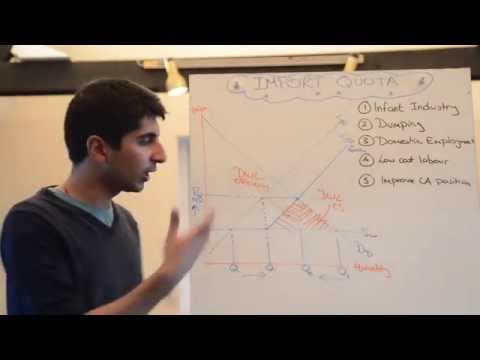 ▶ Topic lesson
A lesson on this topic · by EconplusDal. Tap the picture to open it on YouTube.
Solutions follow the official Cambridge mark schemes; marks are shown in grey. Videos are from other YouTube channels. Paper codes read component / series / year: M/J = May/June, O/N = October/November. Past-paper questions © UCLES, reproduced for classroom practice.