Q17 · 9700/42/F/M/22 Q7
Worked solution from the Energy and respiration Theory (Paper 4) booklet, Part 2 of 2.

Worked solution
(a)
The question asks you to outline oxidative phosphorylation. Give seven clear points in order.
Write: reduced NAD / reduced FAD release hydrogen, which splits into protons and electrons. [1]
Write: this happens at the inner mitochondrial membrane / cristae. [1]
Write: the electrons pass along the electron transport chain (ETC), which releases energy. [2]
Write: the energy is used to transfer protons through the inner membrane into the intermembrane space, setting up a proton gradient. [1]
Write: protons diffuse back through ATP synthase (chemiosmosis) and ATP is produced from ADP and Pi. [1]
Write: oxygen is the final electron acceptor, combining with electrons and protons to form water. [1]
Any seven of these points score; the ones above are the main ones.
(b)
Read Fig. 7.1: at 7 min population B has about 120 μmol dm−3 ATP, but population A has only about 22 μmol dm−3.
Describe: population B produces more ATP than population A. [1]
Describe: ATP rises at a higher rate in B: from 5 to 7 min B rises from about 50 to 120 μmol dm−3, while A rises only from about 20 to 22 μmol dm−3. [1]
Give a paired data quote: at 6 min B is about 100 μmol dm−3 and A is about 22 μmol dm−3. [1]
Explain: population B has mitochondria, so it carries out glycolysis / substrate-linked phosphorylation and oxidative phosphorylation. Population A carries out only glycolysis / anaerobic respiration (fermentation) and cannot carry out oxidative phosphorylation, so it makes much less ATP. [1]
Any four marks from the points above in total.
Official mark scheme

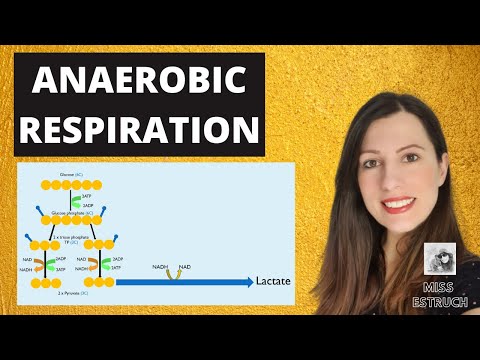 ▶ Topic lesson
A lesson on this topic · by Miss Estruch Biology. Tap the picture to open it on YouTube.
Solutions follow the official Cambridge mark schemes; marks are shown in grey. Videos are from other YouTube channels. Paper codes read component / series / year: M/J = May/June, O/N = October/November. Past-paper questions © UCLES, reproduced for classroom practice.