Q47 · 9708/13/O/N/23 Q3
Worked solution from the International economic issues MCQ booklet.

Worked solution
The question asks which statement is not correct. Work out opportunity costs from the table.
Luke: moving from 18 rings to 12 rings gives 6 bracelets, so 1 ring costs 1 bracelet, constant.
Zoe: moving from 20 rings to 16 rings gives 8 bracelets, so 1 ring costs 2 bracelets, and 1 bracelet costs 0.5 ring (constant).
A is correct: Luke's bracelet costs 1 ring, which is more than Zoe's 0.5. B is correct: both give up a fixed amount each time.
D says Zoe's opportunity cost of a bracelet is 2 rings. It is actually 0.5 ring, so D is incorrect.
So the answer is D.
A and B are correct statements. C can be read as true on output: when both use all their time on rings, Zoe makes more rings than Luke (20 against 18). D is false on any reading, so it is the statement that is not correct.
 ▶ Whole paper
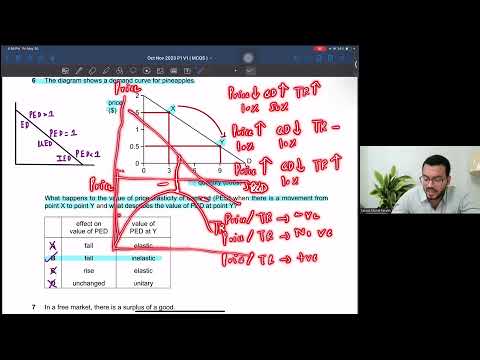
Video solution of the whole paper · by Fahad Munaf Parekh. Tap the picture to open it on YouTube.
Solutions follow the official Cambridge mark schemes. Videos are from other YouTube channels. Paper codes read component / series / year: M/J = May/June, O/N = October/November. Past-paper questions © UCLES, reproduced for classroom practice.