Q36 · 9700/42/F/M/25 Q8
Worked solution from the Energy and respiration Theory (Paper 4) booklet, Part 2 of 2.

Worked solution
(a)
In the link reaction pyruvate loses carbon dioxide and hydrogen.
Write: decarboxylation [1]
Write: dehydrogenation (oxidation) [1]
(b)
Read Fig. 8.1: at 60 arbitrary units of acetyl-coA the activity is about 0.65 without succinyl-coA but only about 0.25 with it. Write any four of these:
Succinyl-coA reduces the activity of citrate synthase (activity is higher without it). [1]
A comparative data quote, for example at 60 units: about 0.65 without and about 0.25 with succinyl-coA. [1]
Succinyl-coA is similar in shape to acetyl-coA, so it binds to the active site of citrate synthase. [1]
It acts as a competitive inhibitor, so fewer enzyme-substrate complexes form. [1]
This slows down the Krebs cycle.
It prevents a build-up of citrate (intermediates).
(Only four marks in total.)
(c)
NAD is a coenzyme that carries hydrogen. Write any four of these:
NAD is a hydrogen carrier (it is reduced). [1]
It is reduced in the link reaction and the Krebs cycle. [1]
It moves to the inner mitochondrial membrane (cristae). [1]
It releases hydrogen atoms (protons and electrons). [1]
These are used in oxidative phosphorylation.
NAD is oxidised and recycled to be used again.
(Only four marks in total.)
Official mark scheme

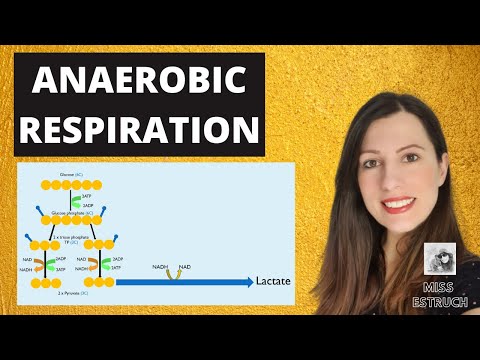 ▶ Topic lesson
A lesson on this topic · by Miss Estruch Biology. Tap the picture to open it on YouTube.
Solutions follow the official Cambridge mark schemes; marks are shown in grey. Videos are from other YouTube channels. Paper codes read component / series / year: M/J = May/June, O/N = October/November. Past-paper questions © UCLES, reproduced for classroom practice.