Q2 · 9706/32/F/M/20 Q2
Worked solution from the Financial accounting (A Level) Theory (Paper 3) booklet, Part 1 of 4.

Worked solution
(a)
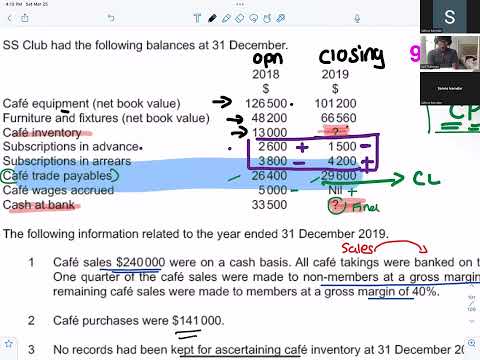
Gross profit comes from the two margins, then cost of sales = sales − gross profit, and closing inventory is the balancing figure.
Workings
Non-member sales = $240 000 × 1/4 × 50% = $30 000 [1]
Member sales = $240 000 × 3/4 × 40% = $72 000 [1]
Gross profit = $30 000 + $72 000 = $102 000
Cost of sales = $240 000 − $102 000 = $138 000
Café trading account for the year ended 31 December 2019
| Details | $ |
|---|---|
| Café sales | 240 000 |
| Opening inventory | 13 000 |
| Purchases | 141 000 |
| Closing inventory (balancing figure) | (16 000) [1] |
| Cost of sales | 138 000 [1] |
| Gross profit | 102 000 [1] |
(b)
Only cash items go in. Each figure is worked out first.
Workings
Subscriptions received = $322 000 + ($3 800 − $2 600) [1]
− ($4 200 − $1 500) = $322 000 + $1 200 − $2 700 = $320 500 [1]
Café trade payables paid = $26 400 + $141 000 − $29 600 = $137 800 [1]
Café wages paid = $46 000 + $5 000 = $51 000 [1]
Increase in furniture and fixtures (net book value) = $66 560 − $48 200 = $18 360 [1]
Furniture and fixtures bought = $18 360 + depreciation $16 640 = $35 000 [1]
Café sales received in cash = $240 000 [1]
Receipts and payments account for the year ended 31 December 2019
| Receipts | $ | Payments | $ |
|---|---|---|---|
| Balance b/d | 33 500 | Café trade payables | 137 800 |
| Subscriptions | 320 500 | Café wages | 51 000 |
| Café sales | 240 000 | Administrative expenses | 251 100 |
| Furniture and fixtures | 35 000 | ||
| Balance c/d | 119 100 | ||
| Total | 594 000 | Total | 594 000 |
Balance b/d (next year) = $119 100. [1]
(c)
Write any two differences:
The income and expenditure account shows revenue and expenditure on an accrual basis; the receipts and payments account shows cash received and paid (cash basis). [1]
The income and expenditure account can include non-cash items such as depreciation and only revenue expenditure; the receipts and payments account has cash items only and can include capital expenditure. [1]
(d)(i)
Write any four of these points:
The donation covers more than one year, so the accrual concept applies. [1]
The revenue from the donation should be matched with the general running expenses of those years. [1]
The donation is capitalised. [1]
It is transferred to the income and expenditure account over a number of years. [1]
(d)(ii)
Write any three of these points:
It is a capital receipt, credited to a capital reserve. [1]
It cannot be recognised in the income and expenditure account. [1]
It should be used for the purpose the donor specified. [1]
The reserve is debited when the pool expenditure is incurred in the future (a further point, no extra mark).
(e)
The club is a not-for-profit organisation: its purpose is social, athletic or charitable, not to make a profit. [1]
Its funds are held in trust for the club and can only be used to carry out its objective. [1]
Advice: the committee is not correct and should not distribute the surplus to members. [1]
Official mark scheme

 ▶ Whole paper
Video solution of the whole paper · by IGCSE / AS LEVEL / A LEVEL MATHS AND ACCOUNTS. Tap the picture to open it on YouTube.
Solutions follow the official Cambridge mark schemes; marks are shown in grey. Videos are from other YouTube channels. Paper codes read component / series / year: M/J = May/June, O/N = October/November. Past-paper questions © UCLES, reproduced for classroom practice.