Q53 · 9700/42/O/N/21 Q10
Worked solution from the Control and coordination Theory (Paper 4) booklet, Part 2 of 2.

Worked solution
(a)
Describe how the dip stick works, step by step. Any seven.
The dip stick has immobilised enzymes. [1]
It is dipped in urine. [1]
The enzymes are glucose oxidase and peroxidase. [1]
Glucose reacts to give hydrogen peroxide. [1]
The hydrogen peroxide reacts with a colourless substance (chromogen) [1]
to give a coloured substance (colour change). [1]
Compare the colour with a colour chart: the darker the colour, the more glucose. [1]
(b)
Explain how gibberellin synthesis is controlled and how it causes stem growth. Any eight points.
The dominant allele (Le) codes for a functional enzyme, which produces active gibberellin (GA). [1]
DELLA protein inhibits the transcription factor PIF (prevents transcription). [1]
Gibberellin binds to a receptor. [1]
This causes DELLA protein destruction. [1]
PIF (transcription factor) binds to the DNA at the promoter. [1]
Growth genes are switched on (transcribed). [1]
Cell walls loosen, so cells can expand when water enters. [1]
This gives cell elongation or division, which increases internode length. (Any eight points.) [1]
Official mark scheme

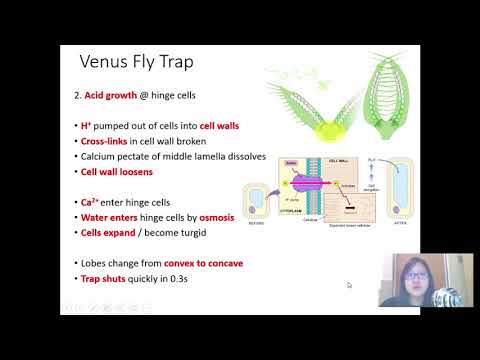 ▶ Topic lesson
A lesson on this topic · by Ms Beh @behlogy | Cambridge A Level Biology (9700). Tap the picture to open it on YouTube.
Solutions follow the official Cambridge mark schemes; marks are shown in grey. Videos are from other YouTube channels. Paper codes read component / series / year: M/J = May/June, O/N = October/November. Past-paper questions © UCLES, reproduced for classroom practice.