Q9 · 9700/42/F/M/20 Q4
Worked solution from the Selection and evolution Theory (Paper 4) booklet, Part 2 of 3.

Worked solution
(a)
The question asks for the number of homozygous brown fish. Blue-silver fish are homozygous recessive (q2). Brown homozygotes are homozygous dominant (p2).
q2 = 1437 ÷ 2936 = 0.489, so q = √0.489 = 0.70 [1]
p = 1 − q = 1 − 0.70 = 0.30 [1]
p2 = 0.30 × 0.30 = 0.09, so number = 0.09 × 2936 = 264 fish (264 to 267 accepted) [1]
(b)
Write any two conditions of the Hardy–Weinberg principle:
The population must be large. [1]
There is no migration into or out of the population (or random mating, or no selection, or no mutation; the organism must also be diploid and reproduce sexually). Any one of these as the second point. [1]
(c)
Selective breeding is artificial selection by humans. Write:
Humans choose which fish breed (artificial selection) and remove brown fish from the breeding population. [1]
Breed together fish that have the blue-silver colour. [1]
Choose the blue-silver offspring to breed again, repeated over several generations. [1]
So the frequency of the blue-silver allele increases, because only that allele is passed on to the offspring. [1]
(d)
Write any two of these:
A gene for faster growth (growth hormone) is inserted into the salmon, together with a promoter from another species so the gene is switched on. [1]
The GM salmon grow all year round (not just spring and summer), so they grow faster or larger, giving more food from each fish. [1]
Official mark scheme

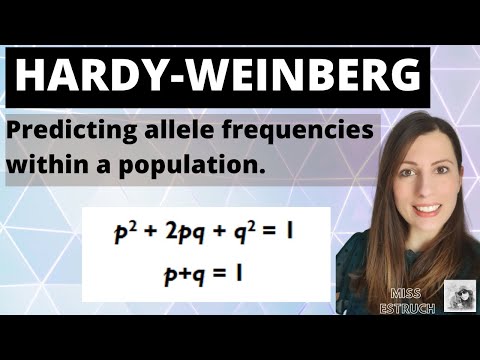 ▶ Topic lesson
A lesson on this topic · by Miss Estruch Biology. Tap the picture to open it on YouTube.
Solutions follow the official Cambridge mark schemes; marks are shown in grey. Videos are from other YouTube channels. Paper codes read component / series / year: M/J = May/June, O/N = October/November. Past-paper questions © UCLES, reproduced for classroom practice.