Q11 · 9700/42/F/M/20 Q3
Worked solution from the Inheritance Theory (Paper 4) booklet, Part 2 of 3.

Worked solution
(a)(i)
An allele is a version of a gene, so write what makes versions differ.
Write: an allele is a different form / variation of the same gene. [1]
Write: the alleles differ in their DNA base (nucleotide) sequence, so they may code for a different polypeptide / protein. [1]
(a)(ii)
Allele R lets pigment be made. Suggest how a gene can do this; any three of these points.
Write: this is an example of gene interaction (epistasis), because gene R/r affects whether gene T/t can show its colour. [1]
Write: allele R may code for an enzyme in the pigment production pathway. [1]
Write: or it may code for a transcription factor that binds to the promoter / enhancer and promotes transcription (RNA polymerase binds, mRNA is made) of the pigment genes. [1]
Other points that also score: R codes for a co-factor that activates an enzyme or blocks an inhibitor.
(b)
Both parents are RrTt. The genes are on different chromosomes, so they assort independently and each parent makes four gametes.
Parental genotypes: RrTt × RrTt [1]
Parental gametes (both parents): RT, Rt, rT, rt [1]
Fill the 4 × 4 grid with the gametes along the top and down the side. Row RT: RRTT, RRTt, RrTT, RrTt (all purple). Row Rt: RRTt purple, RRtt red, RrTt purple, Rrtt red. [1]
Row rT: RrTT purple, RrTt purple, rrTT white, rrTt white. Row rt: RrTt purple, Rrtt red, rrTt white, rrtt white. [1]
Count: purple needs R and T (9 boxes), red needs R and tt (3 boxes), white is any rr (4 boxes). Write phenotypic ratio 9 purple : 3 red : 4 white [1]
Official mark scheme

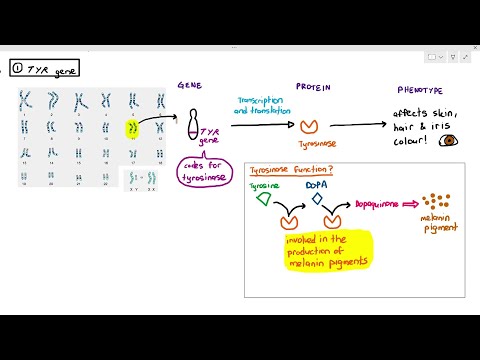 ▶ Topic lesson
A lesson on this topic · by OtterBioTutor. Tap the picture to open it on YouTube.
Solutions follow the official Cambridge mark schemes; marks are shown in grey. Videos are from other YouTube channels. Paper codes read component / series / year: M/J = May/June, O/N = October/November. Past-paper questions © UCLES, reproduced for classroom practice.