Q21 · 0620/43/O/N/25 Q5
Worked solution from the The Periodic Table Theory (Paper 4) booklet, Part 3 of 3.

Worked solution
(a)(i)
Lead(II) ions have the formula Pb2+ and sulfate ions are SO42−. They join to make solid PbSO4.
Only PbSO4 on the right. [1]
Only Pb2+ and SO42− on the left. [1]
Pb2+(aq) + SO42−(aq) → PbSO4(s) with correct state symbols. [1]
(a)(ii)
Most lead(II) salts are insoluble, but the nitrate is soluble.
Write lead(II) nitrate. [1]
(a)(iii)
We need a soluble sulfate.
Write sodium sulfate (also accepted: potassium sulfate or ammonium sulfate). [1]
(a)(iv)
The solid that stays on the filter paper is called the residue. [1]
(a)(v)
The solid still has soluble impurities on it, so rinse them away, then dry it.
Wash with distilled water. [1]
Dry it, for example in a warm oven or between filter papers. [1]
(b)(i)
Choose any two from the list that Group I metals also show.
Good conductor of electricity [1]
Forms soluble salts (also accepted: forms basic oxides). [1]
(b)(ii)
Choose any two from the list that Group I metals do not show.
Variable oxidation states [1]
Forms coloured compounds (also accepted: acts as a catalyst). [1]
Official mark scheme

 ▶ Whole paper
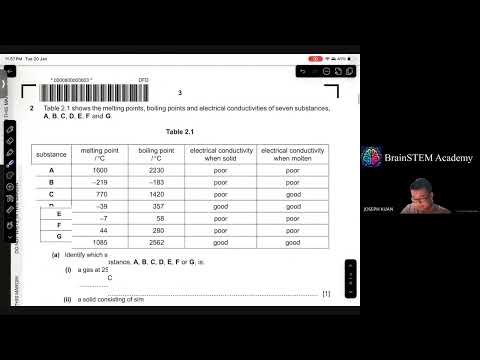
Video solution of the whole paper · by Teacher Joseph Kuan - IGCSE Chemistry Online Tutor. Tap the picture to open it on YouTube.
Solutions follow the official Cambridge mark schemes; marks are shown in grey. Videos are from other YouTube channels. Paper codes read component / series / year: M/J = May/June, O/N = October/November. Past-paper questions © UCLES, reproduced for classroom practice.