Q13 · 9609/32/F/M/23 Q5
Worked solution from the Finance and accounting Theory (Paper 3) booklet, Part 2 of 4.

Worked solution
(a)
Judgement: FWB's ratio analysis is useful to the directors as a warning and a guide, but it is not enough on its own.
Knowledge: accounting ratios measure performance, efficiency, liquidity and returns to owners. Gearing shows how much the business depends on debt finance and helps decide how to finance growth. Inventory turnover measures efficiency, and a higher number is more efficient, so it guides inventory decisions. Liquidity ratios show the ability to meet short-term debts and guide short-term finance. Profitability ratios show the ability to earn profit from sales or assets and guide pricing and cost control. Ratios also help decisions on budgets, dividends and borrowing.
Application: FWB's gearing rose from 35% to 45%, close to 50%, so the directors must be careful about borrowing to expand into international markets or to fund ERP. ROCE fell from 4.9% to 4.2% and profit margin from 6.4% to 5.3% (about $2.1465m profit last year). Trade payables days rose from 30 to 35, and inventory turnover fell from 14 to 12, so inventory is held for about 30 days. The current ratio of 1.3:1 shows enough short-term assets to cover short-term debts.
Analysis: gearing of 45% is below 50%, so managers may see more borrowing as low risk, but a high level raises the risk of being unable to pay interest, so it affects whether to choose debt or shares. Falling profitability shows managers need to act on costs to raise returns and please shareholders. Falling inventory turnover warns of a risk of poorer product quality from older inventory, so managers might introduce JIT stock control to improve customer satisfaction. Ratios use numbers, which makes decisions more objective and better quality.
Evaluation: most of the ratios have worsened, which is a warning that the directors need to find out why and decide what to do for 2024 and later. However, one ratio on its own is not enough: the current ratio needs the acid test ratio as well. Ratios show what has happened but not the cause of problems, and they need comparison with other firms. They are also only quantitative, while managers also consider qualitative factors such as the external environment (for example higher interest rates affecting borrowing). Departments may interpret ratios in biased ways, and too much emphasis on ratios can neglect other factors. So ratios are a useful starting point, but the decisions also depend on other information.
This earns the top level for knowledge: ratio analysis and its links to decisions are developed. [2]
It earns the top level for application: developed application to FWB's gearing, ROCE, profit margin, trade payables days and inventory turnover. [2]
It reaches the top level for analysis: two or more links in chains from ratio to decision. [2]
It reaches Level 3 for evaluation: a developed judgement in context that balances the usefulness of ratios against their limits. [6]
Official mark scheme

 ▶ Whole paper
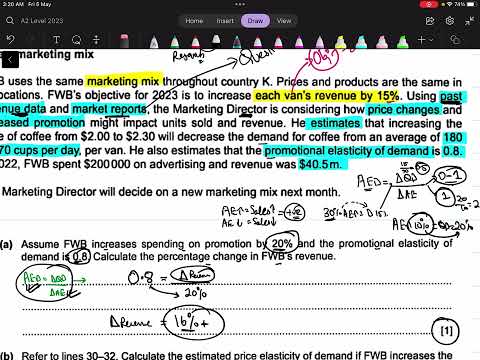
Video solution of the whole paper · by Bilal Kurd. Tap the picture to open it on YouTube.
Solutions follow the official Cambridge mark schemes; marks are shown in grey. Videos are from other YouTube channels. Paper codes read component / series / year: M/J = May/June, O/N = October/November. Past-paper questions © UCLES, reproduced for classroom practice.