Q49 · 9700/43/M/J/20 Q10
Worked solution from the Control and coordination Theory (Paper 4) booklet, Part 2 of 2.

Worked solution
(a)
The question asks how touching the sensory hairs leads to the trap closing. Describe the steps in order, with the explanation.
Write: mechanical energy is converted to electrical, and the cell membrane depolarises. [1]
Write: an action potential occurs if at least two hairs are touched (within about 35 seconds). [1]
Write: the action potential / depolarisation spreads over the leaf / lobe to the hinge / midrib cells. [1]
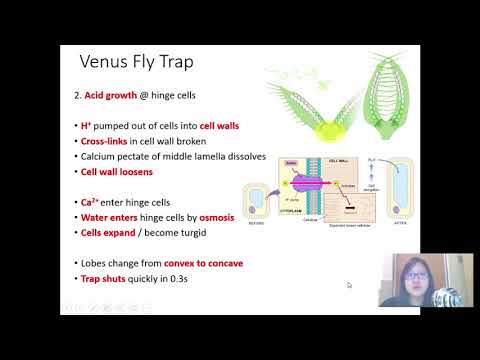
Write: H+ (protons) are pumped out of the cells into the cell walls, so the cell wall loosens / cross-links are broken. [1]
Write: calcium pectate dissolves in the middle lamella and Ca2+ ions enter the cells. [1]
Write: water enters by osmosis, so the cells expand and become turgid. [1]
Write: the leaf lobes change from convex to concave, so the trap shuts very quickly (in less than 1 s, about 0.3 s). [2]
Any eight marks from these points.
(b)
Homeostasis is maintaining a constant internal environment despite changes in the internal or external environment. [2]
Principles: a change in a factor (stimulus) is detected by a receptor, e.g. temperature, water potential or blood glucose concentration. [1]
Write: impulses go to the CNS (input), which makes a decision (central control). [1]
Write: impulses or hormones go to the effector (output), e.g. a named muscle or gland. [1]
Write: the effector takes corrective action, the factor returns to the set point, and this is negative feedback, with fluctuations around the set point. [2]
Any seven marks from these points.
Official mark scheme

 ▶ Topic lesson
A lesson on this topic · by Ms Beh @behlogy | Cambridge A Level Biology (9700). Tap the picture to open it on YouTube.
Solutions follow the official Cambridge mark schemes; marks are shown in grey. Videos are from other YouTube channels. Paper codes read component / series / year: M/J = May/June, O/N = October/November. Past-paper questions © UCLES, reproduced for classroom practice.