Q39 · 9706/22/F/M/20 Q1
Worked solution from the Financial accounting (AS Level) Theory (Paper 2) booklet, Part 4 of 5.

Worked solution
(a)
The question asks for S Limited's income statement. First work out the two figures that need working: closing inventory and administrative expenses.
W1 Closing inventory. The damaged goods cost $5 000 but can only be sold for $3 000 after $700 of repairs, so their net realisable value is $3 000 − $700 = $2 300. Inventory is valued at the lower of cost and net realisable value, so write it down by $5 000 − $2 300 = $2 700.
Closing inventory = $134 200 − $2 700 [1]
= $131 500 [1]
W2 Administrative expenses = amount paid − opening accrual − closing prepayment (own figures from the question)
$298 875 − $3 875 (accrued at 1 January, belongs to last year) [1]
− $7 500 (prepaid at 31 December, belongs to next year) [1]
= $287 500 [1]
Finance costs: 6% × $100 000 × 4/12 (the debenture was issued on 1 September, so it ran for 4 months) = $2 000
S Limited Income statement for the year ended 31 December 2019
| Details | $ | $ |
|---|---|---|
| Revenue | 998 400 | |
| Opening inventory | 122 000 | |
| Purchases | 435 000 | |
| 557 000 | ||
| Less closing inventory (W1) | (131 500) | |
| Cost of sales | (425 500) [1] | |
| Gross profit | 572 900 [1] | |
| Administrative expenses (W2) | 287 500 | |
| Distribution costs | 84 475 | |
| (371 975) | ||
| Profit from operations | 200 925 [1] | |
| Finance costs | (2 000) [1] | |
| Profit for the year | 198 925 [1] |
(b)
Explain means: give the point, then why it matters.
Write: the bonus issue was paid for using the capital reserves (here the share premium) before the revenue reserves (retained earnings), [1]
so that the retained earnings are kept available to pay dividends in the future. [1]
(c)
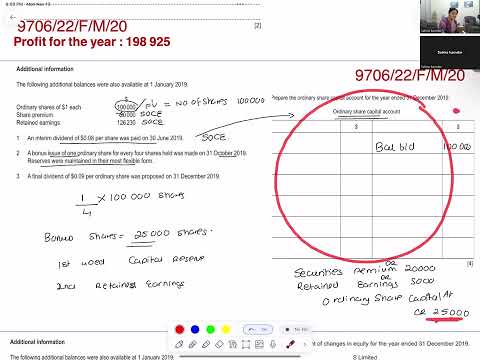
The bonus issue is 1 share for every 4 held: $100 000 ÷ 4 = 25 000 new $1 shares, so $25 000 is added to share capital. It is paid for first from the share premium ($20 000) and then from retained earnings ($5 000).
Ordinary share capital account
| Date | Details | $ | Date | Details | $ |
|---|---|---|---|---|---|
| 2019 Dec 31 | Balance c/d | 125 000 | 2019 Jan 1 | Balance b/d | 100 000 [1] |
| Oct 31 | Share premium | 20 000 [1] | |||
| Oct 31 | Retained earnings | 5 000 [1] | |||
| 125 000 | 125 000 | ||||
| 2020 Jan 1 | Balance b/d | 125 000 [1] |
(d)
Interim dividend = $0.08 × 100 000 shares (the shares in issue on 30 June, before the bonus issue) = $8 000, taken from retained earnings.
The bonus issue moves $20 000 out of share premium and $5 000 out of retained earnings into share capital, so the total does not change. The profit for the year is from (a).
S Limited Statement of changes in equity for the year ended 31 December 2019
| Details | Share capital $ | Share premium $ | Retained earnings $ | Total $ |
|---|---|---|---|---|
| Balance at 1 January | 100 000 | 20 000 | 126 230 | 246 230 |
| Dividend paid | (8 000) | (8 000) [1] | ||
| Bonus issue from share premium | 20 000 | (20 000) | – [1] | |
| Bonus issue from retained earnings | 5 000 | (5 000) | – [1] | |
| Profit for the year | 198 925 | 198 925 [1] | ||
| Balance at 31 December | 125 000 | – | 312 155 | 437 155 [1] |
(e)
Advise means: give the points for each option, then make a decision and support it. Write any four points for each option.
Option 1: 6% debenture
It is loan capital that must be repaid. [1]
Interest of $3 000 must be paid every year (6% × $50 000). [1]
It increases external borrowings. [1]
Security is required for the loan. [1]
(Also accepted: debenture holders have no voting rights.)
Option 2: rights issue
It brings in permanent capital that is not repaid. [1]
Dividend payments are discretionary, so the company does not have to pay them every year. [1]
Shareholders have voting rights. [1]
No security is required. [1]
(Also accepted: it increases the equity holding.)
Decision: write which option the directors should choose, then justify it using the points above. [1]
Official mark scheme

 ▶ Whole paper
Video solution of the whole paper · by IGCSE / AS LEVEL / A LEVEL MATHS AND ACCOUNTS. Tap the picture to open it on YouTube.
Solutions follow the official Cambridge mark schemes; marks are shown in grey. Videos are from other YouTube channels. Paper codes read component / series / year: M/J = May/June, O/N = October/November. Past-paper questions © UCLES, reproduced for classroom practice.