Q13 · 9700/41/O/N/21 Q1
Worked solution from the Homeostasis Theory (Paper 4) booklet, Part 1 of 2.

Worked solution
(a)
Use Fig. 1.1: A is the afferent vessel, B the efferent vessel, C the Bowman's capsule, D the proximal convoluted tubule, E the loop of Henle, F the distal convoluted tubule and G the collecting duct.
Efferent blood vessel: B [1]
Cells that respond to ADH (distal tubule and collecting duct): F, G [1]
Podocytes (in the Bowman's capsule): C [1]
Cells in the medulla (loop of Henle and collecting duct): E, G [1]
(b)
Describe a feature of the cell, then explain how it helps. Give any five points.
Write: microvilli (and basal membrane folds) give a large surface area. [1]
Write: many transport proteins (carrier proteins). [1]
Write: Na+ and glucose or amino acids are co-transported into the cell from the filtrate. [1]
Write: Na+ is pumped out of the cell to the blood (tissue fluid) by active transport. [1]
Write: many mitochondria give energy (ATP). [1]
(c)(i)
Read Fig. 1.2: at −20% the ADH concentration is about 14.5 arbitrary units, at −10% about 8.5, and at 0% it is 2.
Write: as the water potential of the blood increases, the ADH concentration decreases. [1]
Write: between 0% and +10% change, ADH stays constant (plateaus) at 2 arbitrary units. (Two ADH figures matched to two water potential figures also score.) [1]
(c)(ii)
Low ADH means less water is reabsorbed, so more water is lost in urine.
Write: the blood volume (pressure) decreases. [1]
Official mark scheme

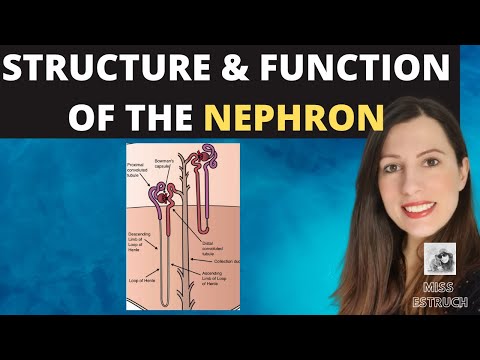 ▶ Topic lesson
A lesson on this topic · by Miss Estruch Biology. Tap the picture to open it on YouTube.
Solutions follow the official Cambridge mark schemes; marks are shown in grey. Videos are from other YouTube channels. Paper codes read component / series / year: M/J = May/June, O/N = October/November. Past-paper questions © UCLES, reproduced for classroom practice.