Q1 · 9701/23/M/J/21 Q5
Worked solution from the Carboxylic acids and derivatives Theory (Paper 2) booklet, Part 1 of 2.

Worked solution
(a)
Sodium reacts with every acidic OH. Citric acid has 3 COOH groups and 1 alcohol OH, so 4 sodium atoms are used and hydrogen gas is made. 4 H are replaced, which gives 2H2.
In the product, write each of the three COOH groups as COONa (or COO–Na+). [1]
Write the alcohol OH as ONa (or O–Na+). [1]
Balance the equation with 4Na on the left and 2H2 as a product. [1]
(b)(i)
X has the same groups as citric acid: COOH and OH. It is C3H6O3. It has a chiral centre and the OH is oxidised, so the OH is on a secondary carbon.
Draw 2-hydroxypropanoic acid, CH3–CH(OH)–COOH, in skeletal form. [1]
Put an asterisk (*) on the carbon that holds the OH, because it has four different groups. [1]
(b)(ii)
Citric acid has a tertiary alcohol group, so it is not oxidised by acidified dichromate. [1]
X has a secondary alcohol group, which is oxidised (to a ketone), so the orange dichromate turns green. [1]
(c)
Write feature 1: a chiral centre (a carbon bonded to four different groups), giving non-superimposable mirror images. [1]
Write feature 2: a C=C double bond where each carbon is attached to two different groups (cis-trans isomerism). [1]
(d)
Structural isomers are molecules with the same molecular formula but different structural formulae (different arrangements of atoms). [1]
Official mark scheme

 ▶ Whole paper
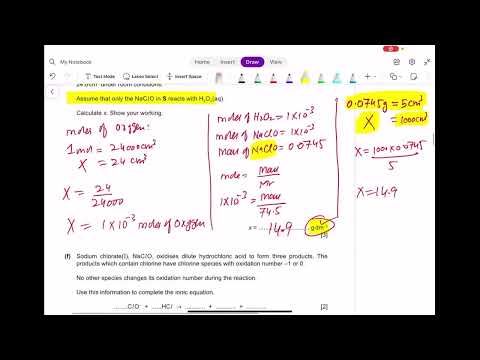
Video solution of the whole paper · by ChemBridge. Tap the picture to open it on YouTube.
Solutions follow the official Cambridge mark schemes; marks are shown in grey. Videos are from other YouTube channels. Paper codes read component / series / year: M/J = May/June, O/N = October/November. Past-paper questions © UCLES, reproduced for classroom practice.