Q21 · 9701/42/F/M/24 Q2
Worked solution from the Equilibria Theory (Paper 4) booklet, Part 1 of 2.

Worked solution
(a)(i)
An acid gives away H+ and becomes its conjugate base. In the forward reaction H2O gives H+ to NO2−.
Write acid I = H2O, conjugate base of acid I = OH−; acid II = HNO2, conjugate base of acid II = NO2−. [1]
(a)(ii)
Write: the lone pair on the N atom can accept (or bond to) a proton, H+, forming a dative bond. [1]
(a)(iii)
Here water accepts H+ from the acid.
Write H2O + CH3COOH → H3O+ + CH3COO−. [1]
(b)(i)
Write Kw = [H+][OH−]. [1]
(b)(ii)
The graph shows Kw rises as temperature rises, so the equilibrium moves right when heated.
Write the dissociation is endothermic, because Kw increases with temperature (equilibrium shifts right, water dissociates more). [1]
(b)(iii)
At 30 °C, Kw from the graph is about 1.50 × 10⁻¹⁴.
Neutral means [H+] = [OH−], so [H+] = √(1.50 × 10⁻¹⁴) = 1.22 × 10⁻⁷, so neutral pH = 6.91. Write Kw increases with temperature so the pH of a neutral solution falls (to about 6.91). [1]
pH 7.00 is above the neutral pH, so [OH−] > [H+] and the solution is alkaline. [1]
(c)(i)
Write: liquid water has more randomness (disorder), or more ways of arranging particles and energy, than ice. [1]
(c)(ii)
Write: gas particles have much more randomness (disorder), or many more ways of arranging particles and energy, than the liquid. [1]
(c)(iii)
At the melting point ΔG = 0, so ΔH = TΔS and T = ΔH ÷ ΔS.
ΔS = 70.1 − 48.0 = 22.1 J K−1 mol−1. Change ΔH to joules: 6030 J mol−1.
T = 6030 ÷ 22.1 = 272.85 K, about 273 K, which is 0 °C. [1]
(d)(i)
E°cell = E°(cathode) − E°(anode) = +0.40 − (−1.22)
E°cell = +1.62 V. [1]
(d)(ii)
pH 11 gives [H+] = 10−11, so [OH−] = 10−14 ÷ 10−11 = 1 × 10⁻³ mol dm−3. [1]
z = 2 electrons. E = 0.40 − (0.059 ÷ 2) × log((10−3)2) = 0.40 − 0.0295 × (−6)
E = 0.40 + 0.177 = +0.577 V (at least 2 significant figures). [1]
Official mark scheme

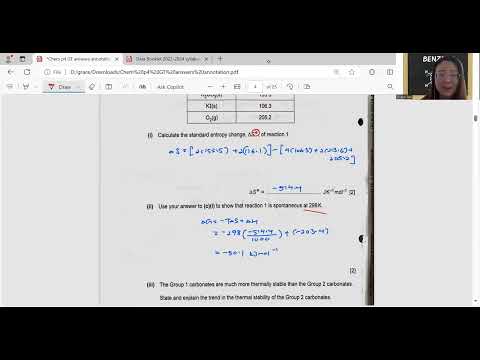 ▶ Starts at Q2 (24:42)
Starts at Q2 (24:42) · by GTChem. Tap the picture to open it on YouTube.
Solutions follow the official Cambridge mark schemes; marks are shown in grey. Videos are from other YouTube channels. Paper codes read component / series / year: M/J = May/June, O/N = October/November. Past-paper questions © UCLES, reproduced for classroom practice.