Q2 · 2059/21/M/J/23 Q1
Worked solution from the Natural resources – an issue of sustainability Theory (Paper 2) booklet, Part 1 of 4.

Worked solution
(a)(i)
Write each name in the area outside Pakistan's international boundary:
Write Afghanistan on the north-west side, beyond the boundary at the top-left [1]
Write Iran on the west side, beyond the western boundary [1]
Write India on the east side, beyond the eastern boundary [1]
(a)(ii)
Put a dot and write K on the coast, beside the Arabian Sea, just east of the place where river X reaches the sea and west of the main mouth of the River Indus [1]
(a)(iii)
The approximate length of the coastline is 1000 km: circle it [1]
(a)(iv)
X is the River Hub (Hab) [1]
Y is the River Ravi [1]
(b)
Any four ways:
A source of water, for drinking and domestic use [1]
For farming / irrigation of fields and crops [1]
To produce hydroelectric power [1]
For transport of people and goods [1]
(c)(i)
From Fig. 1.2, any four:
Mountains / a mountain range that are high [1]
Steep slopes and a valley [1]
Snow and ice with sharp, rocky peaks [1]
A glacier (a river of ice) in the valley [1]
(c)(ii)
Two ways, each with a development:
Way 1: mountains and steep slopes make building roads, railways and settlements difficult [1]
So routes must follow valleys or use tunnels and bridges, which makes construction more expensive [1]
Way 2: the scenery attracts tourists (trekking, climbing) [1]
Which provides jobs for local people in accommodation, tours and souvenirs [1]
(d)
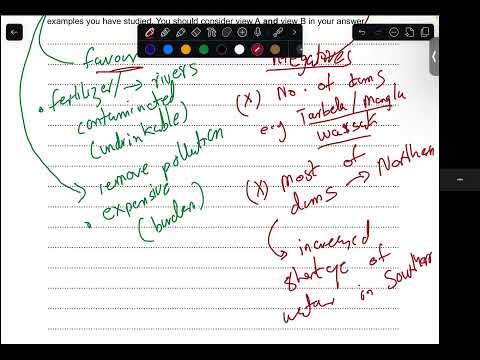
View A (pollution): untreated sewage and industrial effluent make water unusable. Dumping waste in rivers is not strictly regulated, and floods contaminate fresh water. Removing pollution is expensive and reduces the money for water infrastructure. Against A: pollution can be prevented by laws and fines, and bigger threats exist, such as climate change and neighbouring countries limiting water from the headwaters.
View B (dams): rising temperatures increase evaporation from reservoirs, and melting glaciers (like those in the Karakoram shown in Fig. 1.2) mean more dams are needed to store water. More storage would hold heavy monsoon rainfall and help in drought. Against B: there are enough dams already and those under construction should be finished, silting lowers reservoir capacity, existing dams are not where need is greatest, and water conservation is a better solution.
Judgement: I agree more with view A, because without clean water, storing more of it in dams does not help, and pollution is a constant problem while dams can be improved by finishing those already planned.
This reaches Level 3: it gives developed points on both views, with evaluation (a supported judgement) and relevant examples of pollution and dam problems. [6]
Official mark scheme

 ▶ Whole paper
Video solution of the whole paper · by Zohaib Iqbal. Tap the picture to open it on YouTube.
Solutions follow the official Cambridge mark schemes; marks are shown in grey. Videos are from other YouTube channels. Paper codes read component / series / year: M/J = May/June, O/N = October/November. Past-paper questions © UCLES, reproduced for classroom practice.