Q56 · 5070/22/O/N/23 Q5
Worked solution from the Organic chemistry Theory (Paper 2) booklet, Part 7 of 7.

Worked solution
(a)(i)
Bromine reacts with the C=C double bond.
Draw a circle around the C=C only. [1]
(a)(ii)
Aqueous bromine starts as orange. The C=C bond reacts with it and the colour disappears.
Colour of aqueous bromine: orange. [1]
Colour after adding A: colourless (decolourised). [1]
(a)(iii)
Count the atoms in the drawing: 4 carbons, 8 hydrogens and 1 oxygen.
Molecular formula = C4H8O. [1]
(a)(iv)
In a liquid the particles touch and can move past each other.
Motion: sliding (slipping) over each other. [1]
Separation: close together. [1]
(b)
Compound B is but-2-ene (4 carbons with C=C in the middle). When it polymerises, the C=C opens and every carbon in the chain has a CH3 or H group.
Draw a chain of 4 carbons with single bonds and continuation bonds at both ends. [1]
Draw a CH3 group and an H on each carbon, as in the repeat unit –CH(CH3)–CH(CH3)–, twice. [1]
(c)
Write that waste plastic fills up landfill sites. [1]
Write that plastics build up (accumulate) in the oceans, or that toxic gases are made when plastics are burnt. [1]
Official mark scheme

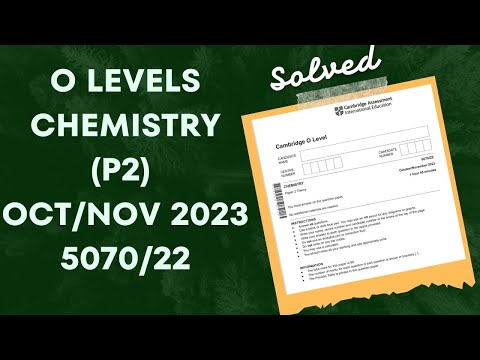 ▶ Whole paper
Video solution of the whole paper · by Sir Rehan. Tap the picture to open it on YouTube.
Solutions follow the official Cambridge mark schemes; marks are shown in grey. Videos are from other YouTube channels. Paper codes read component / series / year: M/J = May/June, O/N = October/November. Past-paper questions © UCLES, reproduced for classroom practice.