Q15 · 9701/42/F/M/24 Q6
Worked solution from the Analytical techniques Theory (Paper 4) booklet, Part 3 of 3.

Worked solution
(a)(i)
The isoelectric point is the pH at which the amino acid has no overall charge (it is a zwitterion and the charges cancel). [1]
(a)(ii)
pH 4 is below 6.2, so the solution is acidic and the NH2 group picks up H+. The COOH stays as COOH.
Write H3N+–CH2–COOH. [1]
(b)(i)
Reaction 1 turns NH2 into N(C2H5)2, a reaction of an amine with a halogenoalkane.
Conditions: ethanol as solvent and heat in a sealed tube (or high pressure). [1]
(b)(ii)
Reaction 2 puts a benzoyl group on the nitrogen to make an amide.
Reagent: C6H5COCl (benzoyl chloride). Benzoic anhydride is also accepted. [1]
(b)(iii)
Excess LiAlH4 reduces both the COOH group and the amide C=O.
COOH becomes CH2OH. [1]
The amide CONH becomes CH2NH. The rest (benzene ring and carbons) stays the same. U is C6H5CH2NHCH2CH2OH. [1]
(b)(iv)
Either amino acid can use its NH2 to bond with the COOH of the other. That gives two different dipeptides.
S: phenylalanine's NH2 joined to glycine's COOH: C6H5CH2CH(COOH)–NH–C(=O)–CH2NH2, with the peptide bond –C(=O)–N(H)– fully displayed. [1]
T: glycine's NH2 joined to phenylalanine's COOH: H2NCH(CH2C6H5)–C(=O)–N(H)–CH2COOH, with the peptide bond fully displayed. [1]
(c)(i)
Think about the lone pair on nitrogen. A base must use it to accept H+.
In an amide, the nitrogen lone pair is delocalised with the C=O. [1]
So the lone pair is less available to accept H+ (less electron density on N), making the amide a weaker base. [1]
(c)(ii)
Chlorine is more electronegative than hydrogen.
Chloroethanoic acid is a stronger acid, because the Cl atom has an electron-withdrawing (–I, inductive) effect. [1]
This weakens the O–H bond and stabilises the carboxylate anion. [1]
(d)(i)
V is HOOC–C6H4–CH2CH2NH2. Use Table 6.1 for each proton.
a (COOH): δ 9.0–13.0, singlet
b (H on the benzene ring): δ 6.0–9.0, multiplet (given)
c (CH2 next to the ring): δ 2.3–3.0, triplet (2 H on the next carbon)
d (CH2 next to N): δ 3.2–4.0, triplet (2 H on the next carbon)
e (NH2): δ 1.0–5.0, singlet
Marks: any 3 correct entries scores 1, any 5 scores 2, any 7 scores 3, all 9 scores 4. [4]
(d)(ii)
In D2O the H on O and N swap with D, so those peaks vanish. C–H peaks stay.
Tick b, c and d. [1]
Official mark scheme

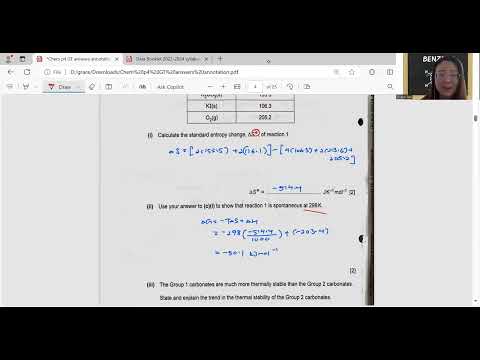 ▶ Starts at Q6 (1:10:13)
Starts at Q6 (1:10:13) · by GTChem. Tap the picture to open it on YouTube.
Solutions follow the official Cambridge mark schemes; marks are shown in grey. Videos are from other YouTube channels. Paper codes read component / series / year: M/J = May/June, O/N = October/November. Past-paper questions © UCLES, reproduced for classroom practice.